
Interview Answer:
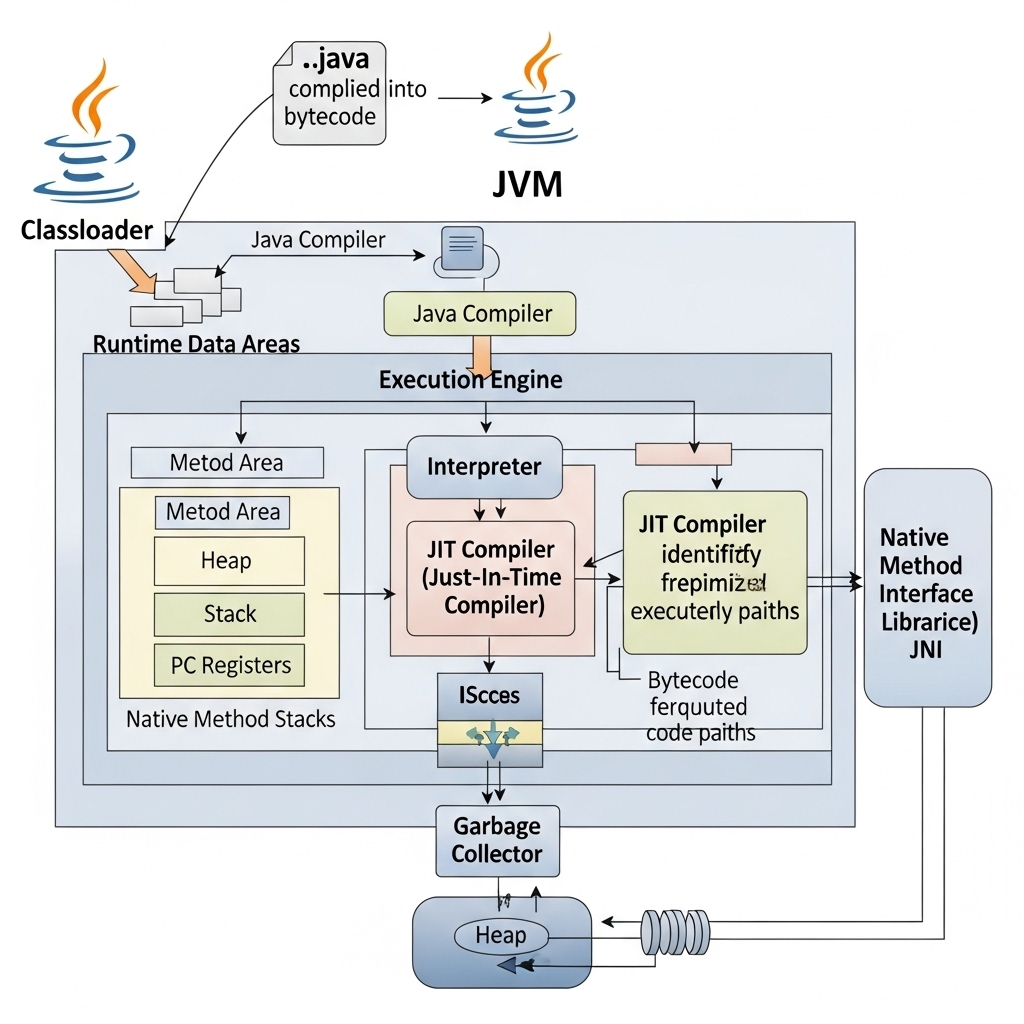
The Java Virtual Machine (JVM) enables Java's “write once, run anywhere” paradigm by abstracting underlying hardware and OS differences. Java execution begins when source code is compiled into bytecode (.class files) by the Java compiler. Bytecode is platform-independent and designed to be executed by any JVM implementation.
When a Java program starts, the JVM loads bytecode into memory using the ClassLoader subsystem. This subsystem supports hierarchical loading, dynamic class linking, and security checks. The bytecode then moves to the runtime execution engine, which interprets instructions or uses the Just-In-Time (JIT) compiler to convert frequently executed bytecode (“hot spots”) into optimized native machine code.
The JVM uses multiple runtime areas: the heap stores objects, the stack stores method frames and local variables, the method area stores class metadata, and the PC register tracks instruction execution. The garbage collector (GC) manages automatic memory reclamation, detecting unreachable objects and freeing memory without developer intervention.
Java uses a security manager, bytecode verifier, and sandboxing rules to enforce robust execution safety. The JVM also includes runtime optimizations such as method inlining, loop unrolling, and escape analysis, allowing Java programs to achieve near-native performance in many scenarios. The combination of JIT compilation, GC, and platform abstraction makes the JVM one of the most advanced runtime environments in modern computing.