
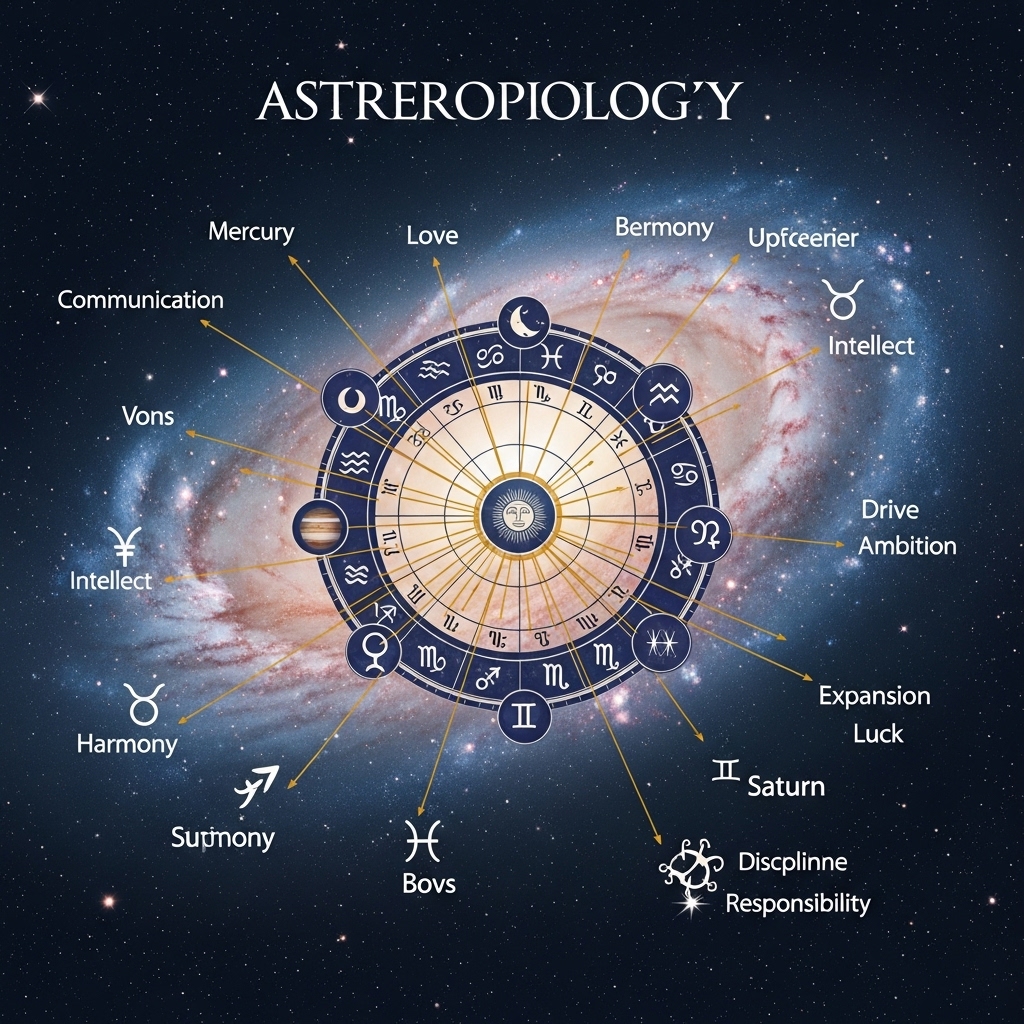
Understanding Planetary Influences in Astrology: How Planets Shape Personality and Destiny
Astrology posits that planetary bodies symbolize distinct psychological drives and life themes. Their positions at the time of birth—mapped in a natal chart—are interpreted as indicators of personality traits, behavioral tendencies, and potential life trajectories. While astrology is a symbolic system rather than an empirical science, its internal logic is systematic and deeply structured.
Core Principle of Planetary Influence
In astrological theory, planets represent “what” energies are active, zodiac signs describe “how” those energies are expressed, and houses indicate “where” in life they manifest. Destiny, therefore, is not viewed as fixed, but as a dynamic interaction between inherent tendencies and conscious choice.
The Personal Planets (Inner Psychology)
These planets move relatively quickly and are considered most influential on day-to-day personality and behavior.
Sun — Core Identity and Purpose
Represents ego, vitality, and life direction
Reflects how an individual seeks meaning and self-expression
Often experienced as one’s “true self”
Moon — Emotional Nature and Subconscious
Governs instincts, emotional reactions, and inner security
Strongly linked to childhood conditioning and emotional needs
Influences how one nurtures and seeks comfort
Mercury — Intellect and Communication
Rules thinking patterns, speech, learning style, and reasoning
Shapes how information is processed and expressed
Central to decision-making and adaptability
Venus — Relationships and Values
Symbolizes love, attraction, aesthetics, and personal values
Influences romantic style, social harmony, and material preferences
Indicates what one finds pleasurable and meaningful
Mars — Drive and Assertion
Governs ambition, energy, courage, and conflict style
Reflects how one pursues goals and handles competition
Closely associated with motivation and willpower
The Social Planets (Life Structure and Growth)
These planets bridge personal psychology and collective experience.
Jupiter — Expansion and Belief Systems
Associated with growth, optimism, wisdom, and opportunity
Indicates areas of life where abundance and learning are emphasized
Also linked to philosophy, ethics, and higher knowledge
Saturn — Discipline and Responsibility
Represents structure, limitation, duty, and long-term effort
Highlights life lessons, challenges, and maturity
Often associated with authority, career, and karmic themes
The Outer (Transpersonal) Planets
These slow-moving planets are thought to influence generations rather than individuals alone.
Uranus — Innovation and Change
Governs rebellion, originality, and sudden transformation
Linked to technological progress and unconventional thinking
Disrupts established patterns to encourage evolution
Neptune — Imagination and Spirituality
Associated with dreams, intuition, compassion, and illusion
Influences artistic sensitivity and spiritual longing
Can blur boundaries, for better or worse
Pluto — Power and Transformation
Symbolizes deep psychological change, destruction, and rebirth
Linked to power dynamics, control, and profound inner shifts
Often manifests through intense, life-altering experiences
Planetary Aspects: The Dynamics Between Forces
Beyond individual planets, astrology emphasizes aspects—the angular relationships between planets.
Harmonious aspects suggest ease and natural talent
Challenging aspects indicate tension that drives growth and self-awareness
These interactions are considered crucial in understanding complexity within personality and life events.
Personality vs. Destiny: An Astrological Perspective
Astrology does not frame destiny as rigid predetermination. Instead:
Planets indicate tendencies, not certainties
Awareness enables conscious choice
Challenges are viewed as developmental opportunities
From this perspective, destiny is shaped by how effectively an individual understands and integrates planetary energies rather than by the planets alone.
Concluding Perspective
Planetary influences in astrology function as a symbolic language describing human experience—linking psychology, timing, and life patterns into a coherent interpretive framework. Whether approached as a tool for self-reflection or cultural study, astrology’s planetary model offers a structured way to explore personality, motivation, and the unfolding of life paths.