
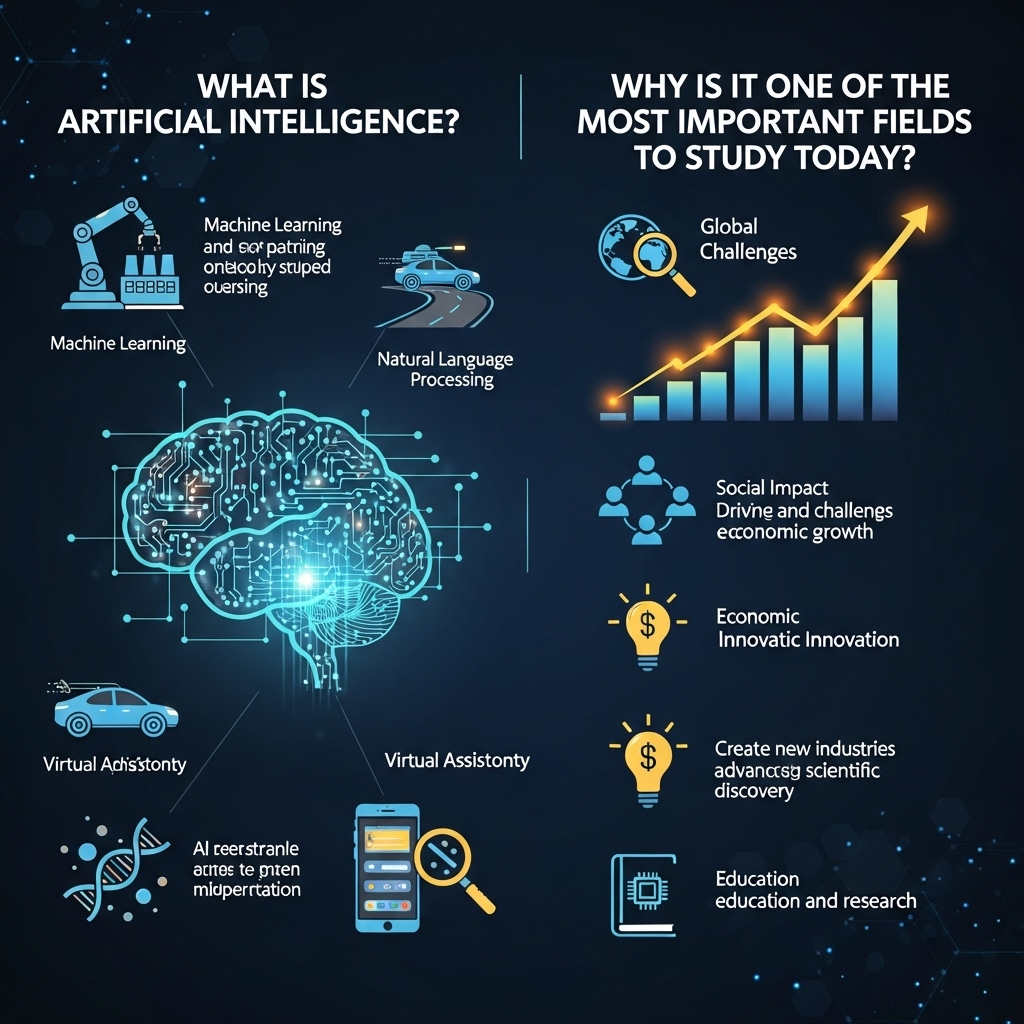
What Is Artificial Intelligence and Why Is It One of the Most Important Fields to Study Today?
Question: What exactly is Artificial Intelligence and why is it considered an essential field for modern technological development?
Answer: Artificial Intelligence (AI) is an interdisciplinary domain dedicated to building systems capable of performing tasks that normally require human intelligence. These tasks include learning from experience, making decisions, understanding language, interpreting images, and solving complex problems. AI integrates principles from computer science, mathematics, data science, neuroscience, ethics, linguistics, and engineering to create intelligent computational models. It serves as the foundation for modern innovations from automated diagnosis systems to self-driving cars.
Machine Learning (ML) and Deep Learning (DL)
Machine Learning allows computers to learn from data, identify patterns, and improve automatically without explicit programming. Deep Learning, a subfield of ML, uses artificial neural networks with multiple layers to perform advanced tasks such as image classification, speech recognition, and natural language understanding. These technologies power major breakthroughs in healthcare, finance, autonomous vehicles, and virtual assistants.
Natural Language Processing (NLP)
NLP enables computers to interpret, understand, and generate human language. It drives applications like translation systems, chatbots, sentiment analysis engines, document summarizers, and intelligent assistants. With large language models, NLP has transformed communication between humans and machines, making AI more accessible and interactive.
Computer Vision
Computer Vision focuses on enabling machines to understand visual data, including images, videos, and real-time camera feeds. It is widely used in facial recognition, security systems, medical imaging, robotics, and autonomous driving. Vision AI helps computers identify objects, detect anomalies, and make decisions based on visual input.
Robotics
Robotics combines mechanical engineering, electronics, and AI to design robots capable of performing automated tasks. Industrial robots handle manufacturing operations, while healthcare robots assist in surgeries, patient rehabilitation, and logistics. AI-driven robots integrate sensors, computer vision, and movement intelligence to work safely and efficiently.
AI Ethics and Societal Impact
As AI technologies advance, ethical considerations become increasingly important. Key issues include data privacy, algorithmic fairness, bias prevention, transparency, accountability, and the impact of automation on jobs. Responsible AI development ensures that AI systems benefit society while minimizing harm.
Real-World Applications and Case Studies
AI is transforming every major industry. Examples include medical diagnosis using AI-assisted radiology, fraud detection in finance, predictive analytics in agriculture, traffic optimization in smart cities, and autonomous systems such as drones and self-driving cars. These real-world applications highlight the practical impact of AI and its growing demand across sectors.
Skills Needed to Study AI
To pursue AI, learners need strong foundations in programming (especially Python), mathematics (linear algebra, calculus, probability, statistics), algorithms, and data science. Beginners can start with freely available online courses, hands-on projects, and certification programs from platforms like Coursera, edX, Udacity, and YouTube tutorial series.
Conclusion
AI is not just a technological discipline—it is a transformational force shaping the future of industries, businesses, medicine, education, and everyday life. Studying AI opens opportunities for innovation, problem-solving, and meaningful global impact.