
Introduction
Cognitive mapping is a powerful tool that has been widely used in various educational institutions across the globe to enhance student learning outcomes. In the context of Indian educational institutions, cognitive mapping can play a vital role in improving the learning experience of students. This article aims to explore the concept of cognitive mapping and its potential to enhance student learning outcomes in Indian educational institutions. We will delve into the various aspects of cognitive mapping, its benefits, and how it can be effectively implemented in Indian schools and colleges.
What is Cognitive Mapping?
Cognitive mapping refers to the process of creating a visual representation of knowledge, ideas, and concepts. It involves creating a map that illustrates the relationships between different pieces of information, helping students to organize, structure, and connect their thoughts. Cognitive mapping can take various forms, including concept maps, mind maps, and semantic maps. These visual representations enable students to identify patterns, relationships, and hierarchies, making it easier for them to understand and retain complex information.
Benefits of Cognitive Mapping in Indian Educational Institutions
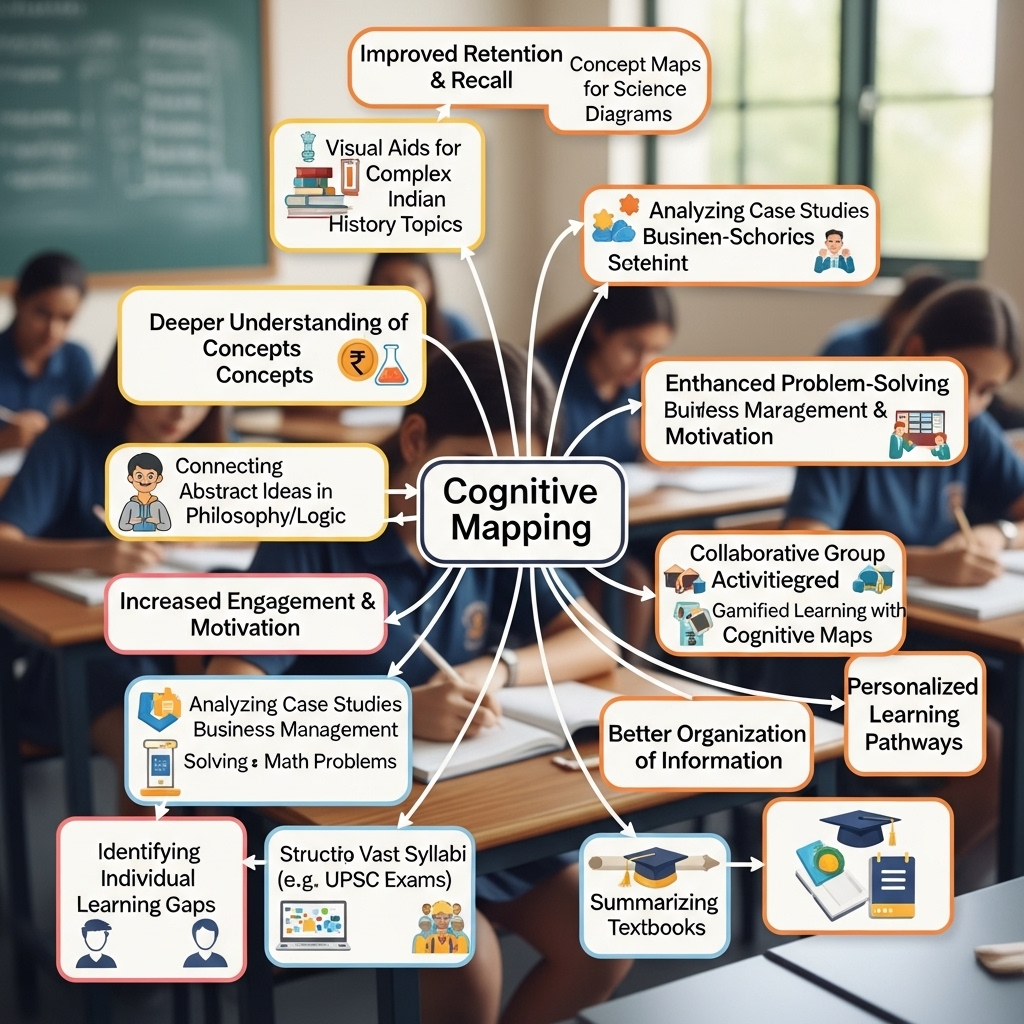
The integration of cognitive mapping in Indian educational institutions can have numerous benefits for students. Some of the key advantages include improved retention and recall of information, enhanced critical thinking and problem-solving skills, and better organization and time management. Cognitive mapping also helps students to identify gaps in their knowledge and understanding, allowing them to focus on areas that require improvement. Furthermore, cognitive mapping promotes active learning, engagement, and participation, making the learning experience more enjoyable and interactive.
Enhancing Student Learning Outcomes through Cognitive Mapping
Cognitive mapping can be used in various ways to enhance student learning outcomes in Indian educational institutions. For instance, teachers can use cognitive mapping to introduce new concepts and ideas, helping students to understand the relationships between different pieces of information. Students can also use cognitive mapping to review and revise course material, identifying areas where they need to focus their attention. Additionally, cognitive mapping can be used to facilitate collaborative learning, with students working in groups to create maps that represent their collective understanding of a particular topic.
Examples of Cognitive Mapping in Indian Educational Institutions
There are several examples of cognitive mapping being used in Indian educational institutions to enhance student learning outcomes. For instance, the Indian Institute of Technology (IIT) in Mumbai has introduced a cognitive mapping program to help students better understand complex engineering concepts. The program involves creating concept maps that illustrate the relationships between different components of a system, enabling students to identify patterns and relationships that might not be immediately apparent. Similarly, the Delhi University has introduced a cognitive mapping initiative to improve student understanding of historical events and concepts. The initiative involves creating timelines and concept maps that help students to visualize the relationships between different historical events and ideas.
Challenges and Limitations of Cognitive Mapping in Indian Educational Institutions
While cognitive mapping has the potential to enhance student learning outcomes in Indian educational institutions, there are also several challenges and limitations that need to be addressed. One of the key challenges is the lack of training and support for teachers, who may not be familiar with the concept of cognitive mapping or may not know how to effectively integrate it into their teaching practices. Another challenge is the limited availability of resources and technology, which can make it difficult for students to create and share cognitive maps. Additionally, cognitive mapping may not be suitable for all types of learners, and teachers need to be aware of the different learning styles and needs of their students.
Conclusion
In conclusion, cognitive mapping has the potential to enhance student learning outcomes in Indian educational institutions. By providing a visual representation of knowledge and ideas, cognitive mapping can help students to better understand and retain complex information. The benefits of cognitive mapping include improved retention and recall, enhanced critical thinking and problem-solving skills, and better organization and time management. While there are challenges and limitations to the implementation of cognitive mapping in Indian educational institutions, these can be addressed through training and support for teachers, as well as the provision of resources and technology. As Indian educational institutions continue to evolve and improve, the integration of cognitive mapping is likely to play an increasingly important role in enhancing student learning outcomes.