
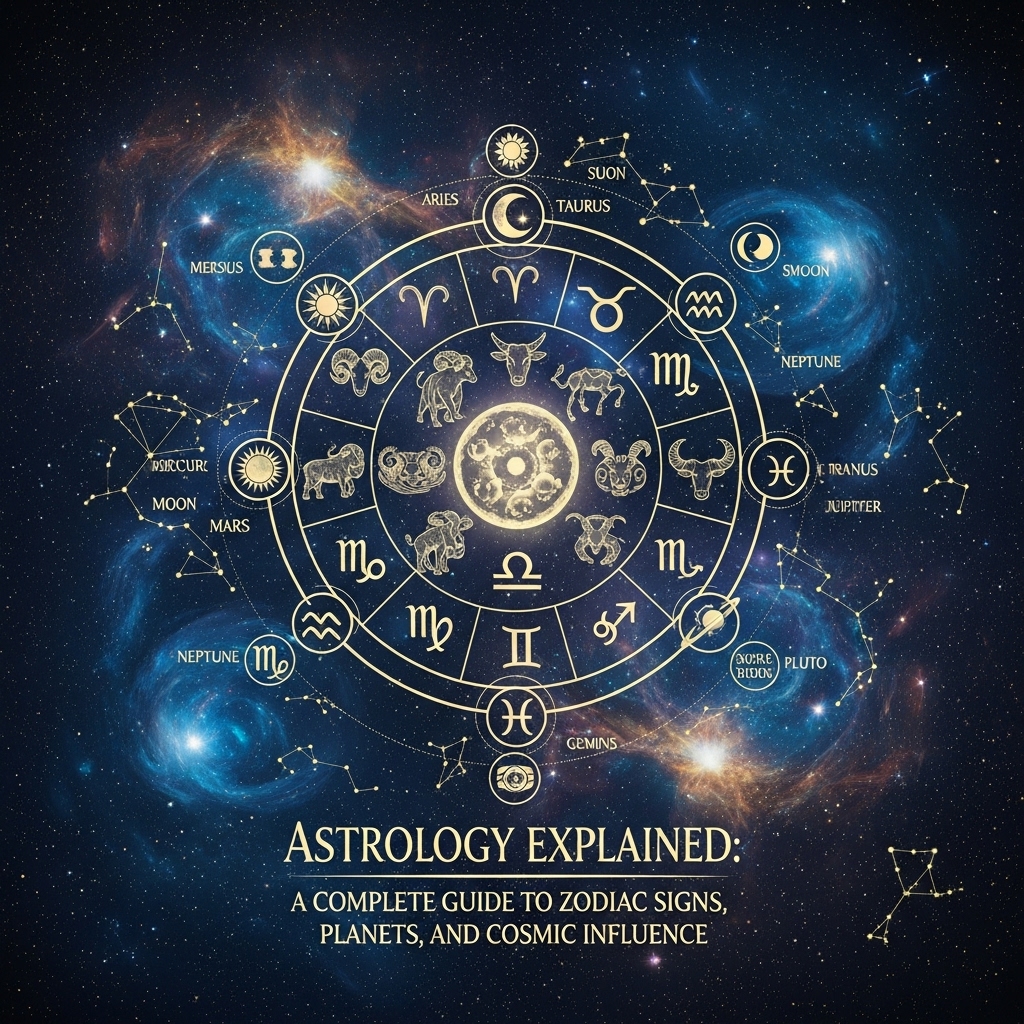
Astrology Explained: A Complete Guide to Zodiac Signs, Planets, and Cosmic Influence
Astrology is one of the oldest systems of knowledge developed by human civilization. Long before modern science existed, humans looked to the sky for meaning, patterns, and guidance. The movement of celestial bodies was observed, recorded, and correlated with events on Earth. Over thousands of years, these observations evolved into what we now recognize as astrology.
In its essence, astrology is the study of how planetary movements and cosmic cycles influence human behavior, personality traits, emotional patterns, and life events. While often misunderstood or oversimplified, astrology is a deep symbolic language that blends astronomy, mythology, mathematics, psychology, and philosophy.
Origins and Historical Evolution of Astrology
The roots of astrology can be traced back more than 5,000 years to ancient Mesopotamia. The Babylonians were among the first to develop a systematic approach to observing the heavens. They associated planetary movements with divine messages and earthly outcomes, laying the foundation for horoscopic astrology.
Astrology later spread to ancient Egypt, where it became intertwined with spiritual beliefs about the soul and the afterlife. The Egyptians contributed significantly to zodiac symbolism and planetary rulerships. Greek philosophers eventually absorbed and refined astrological principles, merging them with logic and mathematics. This Greco-Roman synthesis shaped Western astrology as we know it today.
In parallel, astrology flourished independently in India, China, and Mesoamerica. Indian astrology, also known as Vedic or Jyotish astrology, placed strong emphasis on karma, reincarnation, and spiritual evolution. Chinese astrology focused on cycles of time and animal symbolism, while Mayan astrology aligned closely with advanced calendar systems.
What Astrology Is — And What It Is Not
Astrology is not fortune-telling in the simplistic sense often portrayed in popular media. It does not dictate unavoidable fate, nor does it claim that planets physically cause events on Earth. Instead, astrology operates on the principle of symbolic correlation — the idea that cosmic patterns mirror psychological and experiential patterns in human life.
Astrology also differs fundamentally from astronomy. Astronomy is a physical science that studies celestial objects and phenomena, while astrology is a symbolic system that interprets meaning from celestial cycles. Though they share historical roots, they serve different purposes.
The Zodiac: The Backbone of Astrology
The zodiac is a belt of the sky divided into twelve equal segments, each associated with a constellation and a set of symbolic meanings. These twelve zodiac signs form the foundation of most astrological systems.
The Twelve Zodiac Signs
- Aries – Initiative, courage, leadership, raw energy
- Taurus – Stability, sensuality, patience, material security
- Gemini – Communication, curiosity, adaptability, intellect
- Cancer – Emotion, nurturing, intuition, protection
- Leo – Creativity, confidence, self-expression, vitality
- Virgo – Analysis, service, precision, improvement
- Libra – Balance, harmony, relationships, justice
- Scorpio – Transformation, depth, power, regeneration
- Sagittarius – Expansion, philosophy, freedom, truth-seeking
- Capricorn – Discipline, responsibility, ambition, mastery
- Aquarius – Innovation, independence, collective consciousness
- Pisces – Compassion, imagination, spirituality, transcendence
Each zodiac sign represents a unique mode of experiencing reality. No sign is inherently good or bad; each contains strengths and challenges that contribute to the overall balance of human expression.
The Role of the Planets in Astrology
Planets are the active agents in astrology. They represent psychological drives, instincts, and life functions. Each planet governs specific areas of experience.
Key Astrological Planets
- Sun – Core identity, ego, life force, purpose
- Moon – Emotions, instincts, subconscious patterns
- Mercury – Communication, thinking, learning
- Venus – Love, relationships, values, aesthetics
- Mars – Action, desire, motivation, conflict
- Jupiter – Growth, wisdom, expansion, opportunity
- Saturn – Structure, discipline, responsibility, lessons
- Uranus – Change, innovation, rebellion, awakening
- Neptune – Dreams, illusion, spirituality, compassion
- Pluto – Power, transformation, death and rebirth
In astrology, planets express themselves through zodiac signs and act within specific areas of life known as houses. This interaction creates the unique blueprint of an individual birth chart.
Astrological Houses: Where Life Unfolds
The astrological chart is divided into twelve houses, each representing a different life domain. While zodiac signs describe how energy operates, houses describe where it manifests.
- 1st House – Self, identity, physical appearance
- 2nd House – Money, values, possessions
- 3rd House – Communication, siblings, learning
- 4th House – Home, family, roots
- 5th House – Creativity, romance, pleasure
- 6th House – Work, health, service
- 7th House – Partnerships, marriage
- 8th House – Transformation, shared resources
- 9th House – Philosophy, travel, higher knowledge
- 10th House – Career, reputation, public life
- 11th House – Community, friendships, goals
- 12th House – Spirituality, subconscious, solitude
Birth Charts: The Astrological Blueprint
A birth chart, also known as a natal chart, is a map of the sky at the exact moment of an individual’s birth. It captures the positions of the planets, zodiac signs, and houses, creating a symbolic snapshot of potential strengths, challenges, and life themes.
Unlike sun-sign astrology, which focuses on only one placement, a full birth chart provides a multidimensional view of personality and destiny. This is why two people with the same zodiac sign can be vastly different.
Western vs Vedic Astrology
Western astrology primarily uses the tropical zodiac, which is based on the seasons. Vedic astrology uses the sidereal zodiac, which aligns more closely with actual star positions. While the systems differ in technique, both aim to understand human life through cosmic order.
Vedic astrology places greater emphasis on planetary periods (dashas), karma, and life timing, whereas Western astrology often focuses more on psychology and self-awareness.
Why Astrology Remains Relevant Today
In a fast-paced, technology-driven world, astrology offers a framework for self-reflection and meaning. It helps individuals understand emotional patterns, relationship dynamics, career inclinations, and personal growth cycles.
Astrology does not replace personal responsibility or rational decision-making. Instead, it provides symbolic insight — a language through which people can better understand themselves and their connection to the universe.
Conclusion
Astrology is a vast and ancient system that goes far beyond daily horoscopes. It is a sophisticated symbolic map of human experience, refined across cultures and centuries. Whether approached as a spiritual practice, psychological tool, or cultural tradition, astrology continues to captivate and guide millions around the world.
As you explore astrology further, remember that its greatest value lies not in predicting the future, but in deepening self-awareness, compassion, and understanding of life’s cycles.