
Interview Answer:
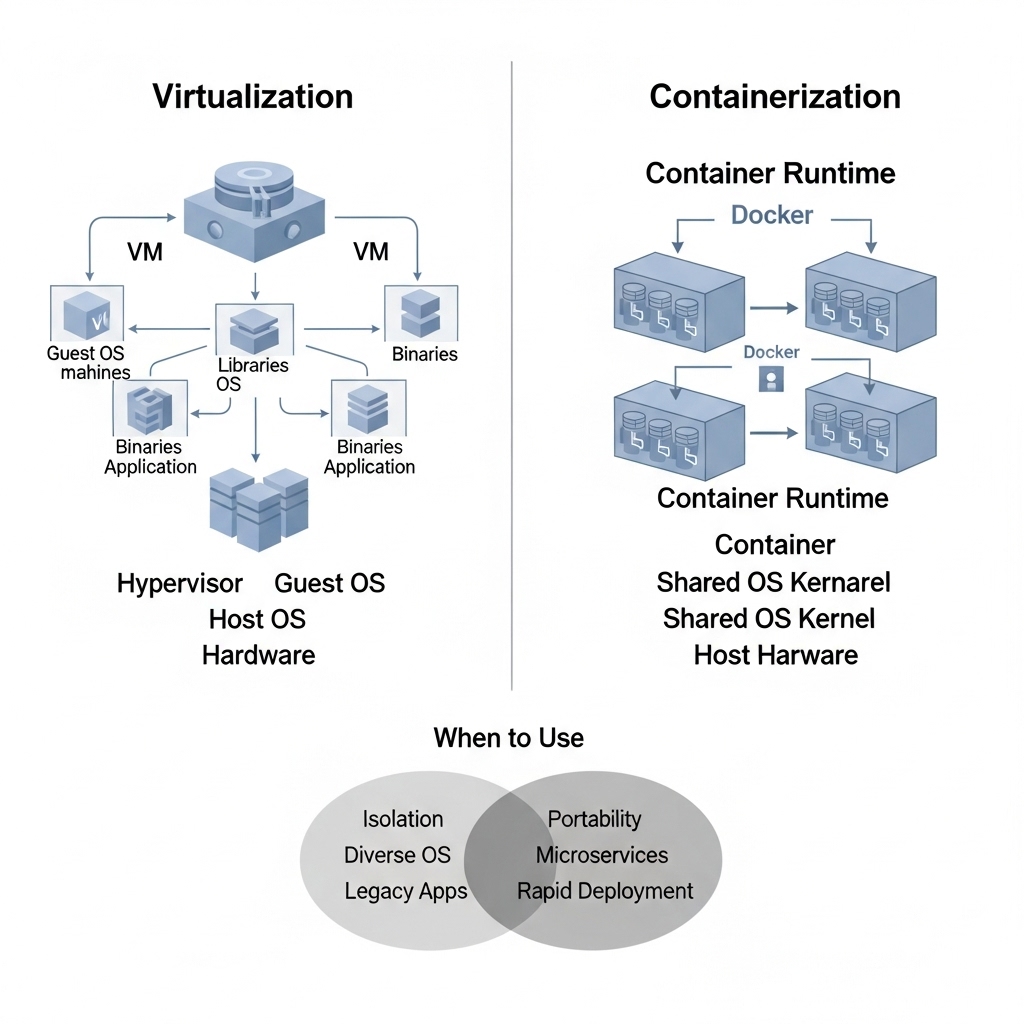
Virtualization and containerization are two different approaches to isolating workloads and deploying applications. Virtualization uses hypervisors (e.g., VMware, KVM) to run multiple operating systems on a single physical machine. Each virtual machine has its own OS, kernel, and resources. This provides strong isolation but incurs heavy overhead due to duplicated OS instances.
Containerization, on the other hand, uses OS-level virtualization. Tools like Docker and Podman package applications along with dependencies but share the host OS kernel. Containers are lightweight, fast to start, and ideal for microservices, cloud-native applications, and CI/CD pipelines.
Virtual machines are preferred when security isolation is critical, when running different operating systems on the same server, or when legacy workloads require full OS support. Containers are ideal for scalable application deployments, stateless services, and environments requiring rapid provisioning.
Organizations often combine both: VMs for infrastructure-level isolation and containers for application-level agility. Kubernetes has further accelerated container adoption by automating orchestration, scaling, and deployment management.