
Interview Answer:
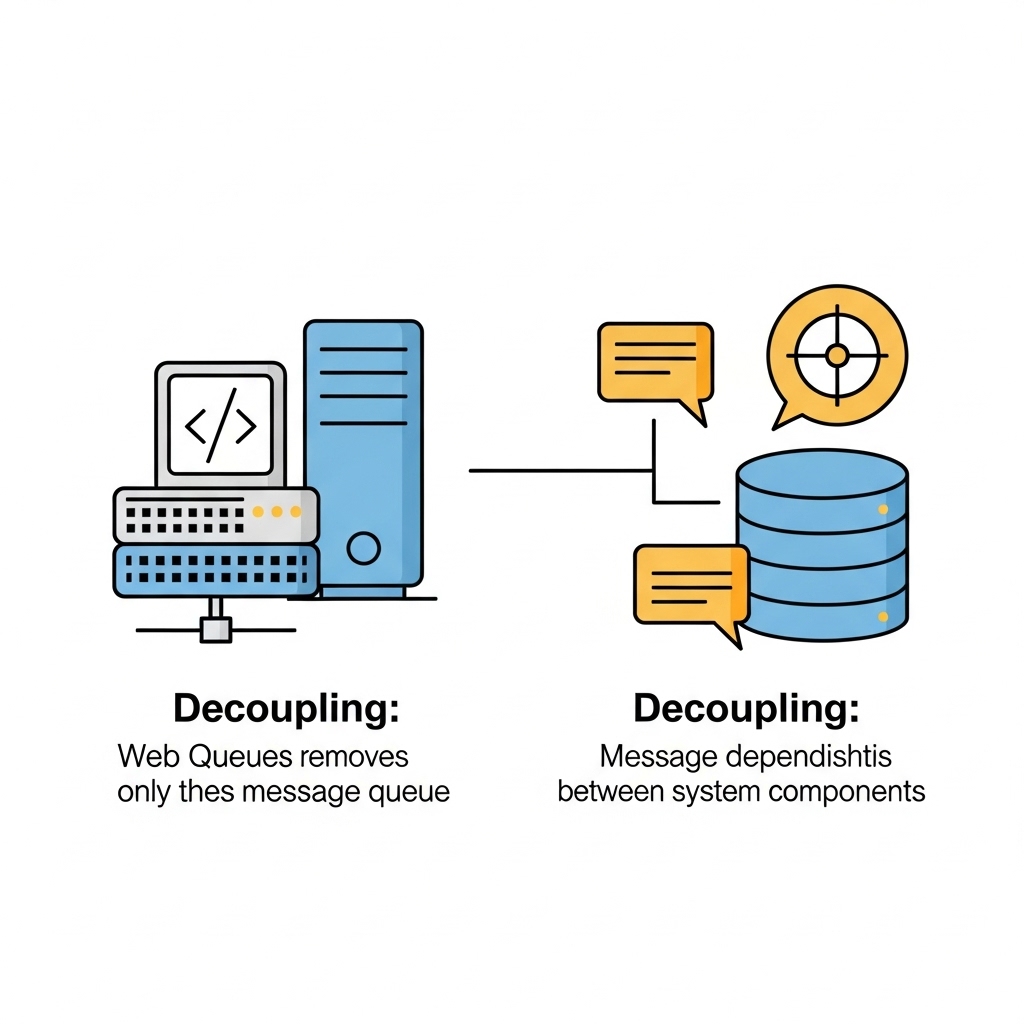
Message queues are a fundamental building block in distributed architectures. They provide an asynchronous communication mechanism that allows producers to send messages without requiring consumers to be available at the same time. A queue acts as a buffer where messages are stored until consumers are ready to process them. This decoupling improves system reliability, scalability, and resilience under varying workloads.
Message queues work on a simple principle: producers publish messages to a queue, and consumers read these messages from the queue. Systems like RabbitMQ, Apache Kafka, AWS SQS, and Azure Service Bus implement this behavior with additional capabilities like message persistence, delivery guarantees, ordering rules, and fault tolerance.
One of the most important contributions of message queues is improving fault tolerance. If a consumer service fails, messages remain in the queue until the service comes back online. This prevents message loss and ensures continuity of processing. Similarly, during traffic spikes, queues absorb the increase in requests, allowing consumers to process them at a stable rate without system overload.
Different delivery models—such as at-most-once, at-least-once, and exactly-once—help developers choose the correct reliability model for their use case. Additionally, queues support scaling via multiple consumers, enabling parallel processing and higher throughput.
Overall, message queues enhance reliability, smooth out spikes, support asynchronous workflows, and decouple microservices, making them critical in modern distributed systems.