
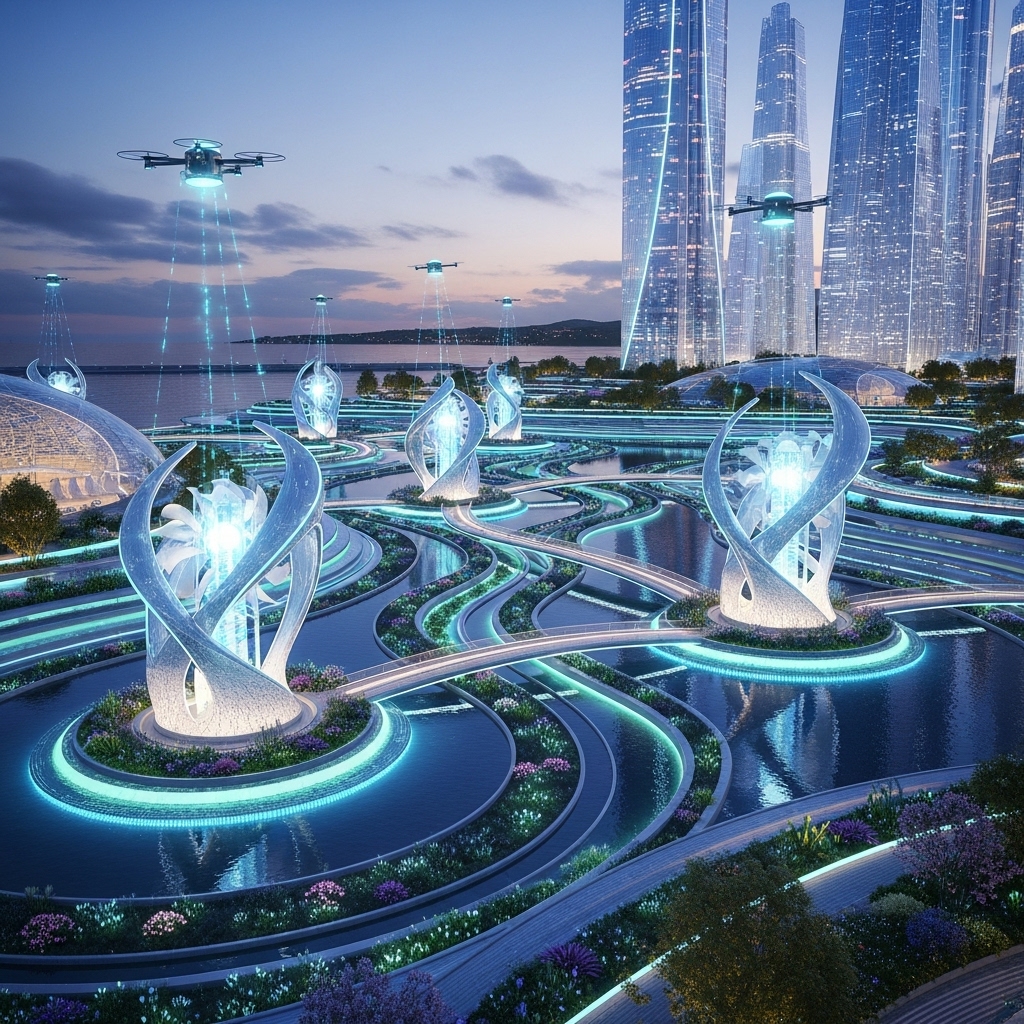
Introduction to a horizon where energy and light are grown
In a city of the near tomorrow energy is no longer stored as a distant artifact but is cultivated as a living system. The concept of a futuristic tidal garden of light combines biology engineering, fluid dynamics, and intelligent control to create bioluminescent microgrids that shimmer with the rhythm of the sea. This is not a single invention but a constellation of technologies that together rewrite the way districts feel, function, and sustain themselves. The aim is to fuse green power generation with aesthetic light, so that every street becomes a corridor of luminous efficiency. The result is a city that breathes in energy through tide and wind, glows with purpose at night, and remains quiet in operation while delivering reliable power to homes, offices, transit hubs, and emergency services. This is a tale of design ethics, technical depth, and social practice woven into a single futuristic thread.
Background of a growing need and a shifting paradigm
Cities around the world face a trio of pressures: increasing demand for clean energy, the imperative to reduce climate and air pollution, and the need to make urban infrastructure more resilient against storms and heat. The traditional grid models are strained by peak loads, aging equipment, and opaque supply chains that obscure the origin of each kilowatt. A future city that uses living organisms, microfluidic networks, and adaptive software to grow energy systems from the shoreline inward presents a radical but practical path forward. The idea rests on three pillars: local energy production, transparent energy provenance, and a user experience that makes power feel like an ally rather than a distant utility. By aligning ecological processes with human rhythms, a tidal garden of light becomes both power source and cultural anchor for a neighborhood.
Core technologies that make a tidal garden possible
Bioluminescent algal channels and microorganelle reactors
Bioluminescent organisms offer a living light source that is responsive, energy efficient, and capable of adjusting brightness to ambient conditions. In a controlled marine environment, engineered algae and bioluminescent bacteria can be cultured within transparent microreactors that couple light output to electrical generation through optoelectronic transducers. The glow is not merely decorative; it serves as a sensor layer indicating nutrient levels, flow rates, and stress signals in the system. By linking light intensity to energy demand signals, the system can produce a modest yet reliable glow while simultaneously powering conversion modules that harvest energy from microturbines and wave pumps. The result is a feedback loop where aesthetics and function reinforce each other rather than compete for attention.
Smart materials and adaptive optics
The second pillar is a class of smart materials that respond to temperature, salinity, and magnetic fields by changing their optical properties. Flexible photonic skins cover the bioluminescent channels to optimize light extraction in varying water depths and tides. Adaptive optics adjust focus and diffusion so that the city experiences a soft, even glow rather than harsh glare. When solar or tidal input shifts, the materials reconfigure automatically to minimize losses and maximize brightness where it matters most. The outcome is a luminous canopy that adapts to weather, traffic, and the energy needs of pedestrians and vehicles, while preserving the night sky from unwanted light pollution. This is energy aligned with urban poetry rather than energy that demands attention through brute illumination.
Microgrid controllers and AI guided orchestration
At the heart of the tidal garden lies a distributed AI controller that coordinates energy production, storage, and distribution across a district. The controller uses machine learning models trained on historical tides, weather, and consumption profiles to forecast demand with high confidence. It negotiates power flows among microreactors, tidal turbines, and energy storage modules in real time. The system is designed to be transparent to residents, with a user friendly dashboard that displays energy provenance, brightness levels, and local emissions avoidance. The AI learns from human feedback, adjusting not only when to brighten public spaces but also how to optimize maintenance schedules and nutrient cycles for the bio components. The goal is a self improving grid that respects human comfort and ecological balance.
System architecture and how the pieces fit
The architecture of a tidal garden microgrid can be understood as a layered ecosystem. At the lowest layer, physical infrastructure includes channels for seawater, bioluminescent reactors, microturbines, and energy storage units such as compact pumped hydro or solid state capacitors. Above that sits the control layer where sensors measure flow, temperature, light, and structural integrity. The AI layer makes decisions about when to run pumps, how to regulate brightness, and which modules to engage during a storm. Finally, the interface layer connects to the public realm through lighting, signage, and rideable boards that communicate energy provenance and usage tips. This layered approach ensures resilience because each layer can compensate for fluctuations in other layers without collapsing the system as a whole.
Detailed look at module types and their roles
Modules are the building blocks of the tidal garden. Each module has a specific function but is designed to be interoperable with others. A typical district might include four types of modules: light producing channels, energy harvesting cells, nutrient management tanks, and structural support frames. Light channels carry bioluminescent organisms and polished optic layers to emit a calibrated glow. Energy harvesting cells convert mechanical energy from tidal movement into electrical energy using piezoelectric or electrochemical processes. Nutrient management tanks provide the nutrients that keep the bio components healthy and responsive. Structural frames ensure durability against storms and salt corrosion while maintaining ease of access for maintenance. The modules connect through a sealed, modular plumbing network that supports scalable growth and rapid replacement of worn parts. While each module has a distinct function, they share a common design language and standard interfaces that enable plug and play upgrades over time.
Module table: an example set and their specs
| Module name | Function | Power contribution | Maintenance cadence |
| Light channel unit | Bioluminescent reactor with smart optics | Low to moderate glow depending on demand | Quarterly bio check and filter swap |
| Bio energy cell | Microturbine style energy harvesting | Medium output during mid tide | Biannual seal and coil inspection |
| Nutrient tank | Bio nutrient reservoir and recycling loop | Supports bio health more than direct energy | Monthly nutrient balance |
| Control hub | AI coordination and data fusion | Broad grid stability contributions | Software update as needed |
Each row in the table represents a modular unit of the broader system. The elegance lies in the way these modules integrate: a brightness request from the public space can be matched with spare capacity from a high tide window, while nutrient schedules ensure algae health for ongoing light production. If a sensor detects an increased salinity that could stress the organisms, the AI rebalances oxygen levels and adjusts lighting to reduce stress while still delivering the required brightness for safety. The system thus behaves like a living organism with a conscious control layer rather than a rigid machine with fixed outputs.
Public value and social implications
The tidal garden is not merely an energy system; it is a social instrument that changes how residents experience the city. The luminous sidewalks guide pedestrians by rhythm rather than color alone, creating a sense of safety and calm. Local schools partner with research labs to study the bio components, turning classrooms into living labs where students observe, measure, and even contribute to nutrient optimization. Local artists collaborate with engineers to design dynamic light compositions that celebrate seasonal cycles, tides, and community events. The hybrid of science and art fosters a shared sense of stewardship because the power of the grid is visible, comprehensible, and tangible in daily life. In this way energy becomes part of local culture rather than a distant service that disappears at closing time.
Environmental benefits and resilience benefits
From an environmental standpoint the tidal garden reduces intercity energy imports, lowers peak demand, and minimizes transmission losses by moving energy generation closer to consumption. The bioluminescent channels provide a low energy per unit light and a rapid response capability that is especially valuable during outages or extreme weather. The modular approach makes maintenance more manageable and reduces disruption to city life because individual modules can be serviced without closing entire neighborhoods. From a climate impact perspective, the approach promotes a low embodied carbon footprint by reducing the need for bulky fossil fueled plants, long high voltage cables, and the associated land use that typically accompanies large scale conventional generation facilities. The resilience story is equally compelling: distributed microgrids tolerate storm damage much better than a single central plant and can reconfigure automatically to maintain critical services such as hospital lighting and emergency communication towers.
Economic and governance considerations
Deploying a tidal garden requires upfront investment in bio reactors, control software, sensors, and durable materials; it also unlocks cost savings through reductions in energy loss, peak pricing, and maintenance overhead. A governance model that emphasizes transparency and open data helps communities understand where the photons come from and how the energy is used. Revenue models can blend public funding, utility partners, and local sponsorships from businesses that value a green city brand. The governance framework should emphasize long term planning, ensure equitable access to the benefits, and maintain strong safety standards around bio components, water quality, and electrical systems. The result is a procurement path that rewards innovation while protecting public health and natural ecosystems.
Implementation timeline and phased growth
Real world deployment typically follows a phased approach. Phase one focuses on pilot installation in a coastal neighborhood with a manageable tidal range and a straightforward supply chain for materials. Phase two expands to several districts with different densities and sea states to test adaptability. Phase three scales to a city district network with integrated public lighting, transit hubs, and emergency response facilities. Each phase emphasizes learning, adjusting design details, and building local capacity for operation and maintenance. The timeline is guided by risk assessment, community engagement, and funding cycles that support long term resilience. The phased approach also reduces the likelihood of schedule slips by aligning procurement with predictable seasonal tides and weather patterns.
Case study imagination: a hypothetical city district
Imagine a district where a tidal garden spreads along a calm waterfront street. The light in the evening glows in a gentle blue and warm amber mix, optimized by the AI to minimize glare while maximizing safety. Residents observe that during high winds the brightness automatically lowers to maintain comfort while keeping pathways clearly visible. During celebrations the system can raise brightness in synchrony with public music performances and art installations. The district gains a new urban identity, and the local energy meters show a clear trace from tidal channels to streetlamps and homes. The social benefits include stronger community ties around shared spaces, increased interest in local science clubs, and a sense of pride in living in a city that experiments with living energy systems in a responsible, transparent, and inclusive way.
Safety, ethics, and environmental stewardship
Safety is the primary constraint in any living energy system. All bio reactors are enclosed in sealed, corrosion resistant housings with redundant containment and fail safe shutoffs. Water quality sensors monitor nutrient levels and prevent contamination. Electrical systems are isolated with robust grounding and surge protection, and regular audits ensure compliance with health and safety regulations. Ethical considerations focus on the welfare of the living components used in energy generation as well as the fair distribution of benefits to all residents. Public engagement channels invite feedback on lighting levels, maintenance schedules, and the overall sense of security and comfort. Environmental stewardship includes ongoing monitoring of local ecosystems, ensuring that the project enhances rather than harms marine life and shoreline habitats. The goal is a harmonious integration of natural processes and human needs in a city that values both science and community.
Future prospects and ongoing research directions
The current prototype paths toward a future where microgrids become sustainable, learnable, and aesthetically integrated within urban life. Ongoing research explores more efficient bio light sources, longer lasting materials, and deeper AI autonomy with human oversight. Advances in nano coatings reduce fouling and corrosion, while smarter nutrient cycles improve organism health and brightness stability. There is interest in extending the concept to inland waterways and reservoirs where similar living light sources can be cultivated in controlled environments that are connected to urban energy networks. The long term vision is a network of tidal gardens that snake along coastlines and inland water bodies, each speaking the same language of transparent energy and adaptive aesthetics, a city that glows with purpose because its glow is earned by careful engineering, responsible governance, and community engagement.
A closing reflection on living energy and urban imagination
The tidal garden is more than a energy system; it is a cultural artifact that reveals how cities can align technology with values. It invites people to see power as something alive, something that responds to care and attention. It invites designers to craft spaces where light and energy are not just resources to be consumed but phenomena to be nurtured. The future city emerges as a place where science fiction becomes practical, where daily life is enriched by science, and where energy security and environmental stewardship grow hand in hand. If the city can learn to glow in harmony with the sea, it can learn to glow in harmony with its people.
Code fragment: a lightweight pseudo snippet for energy routing
load grid data from tide_sensors
for each module in district
  demand = read demand_signal
  supply = get_available_power
  if supply >= demand
    route power to lighting and critical loads
  else
    shed noncritical loads and request external support
  end
end
This short snippet illustrates the logic that underpins the AI controller. It emphasizes the priority of safety and essential services while maintaining a graceful degradation strategy during low input periods. The actual implementation would include robust error handling, secure data streams, and ethical considerations for automated decision making. The important takeaway is not a line of code but the principle of adaptive energy governance through transparent rules and continuous learning.