
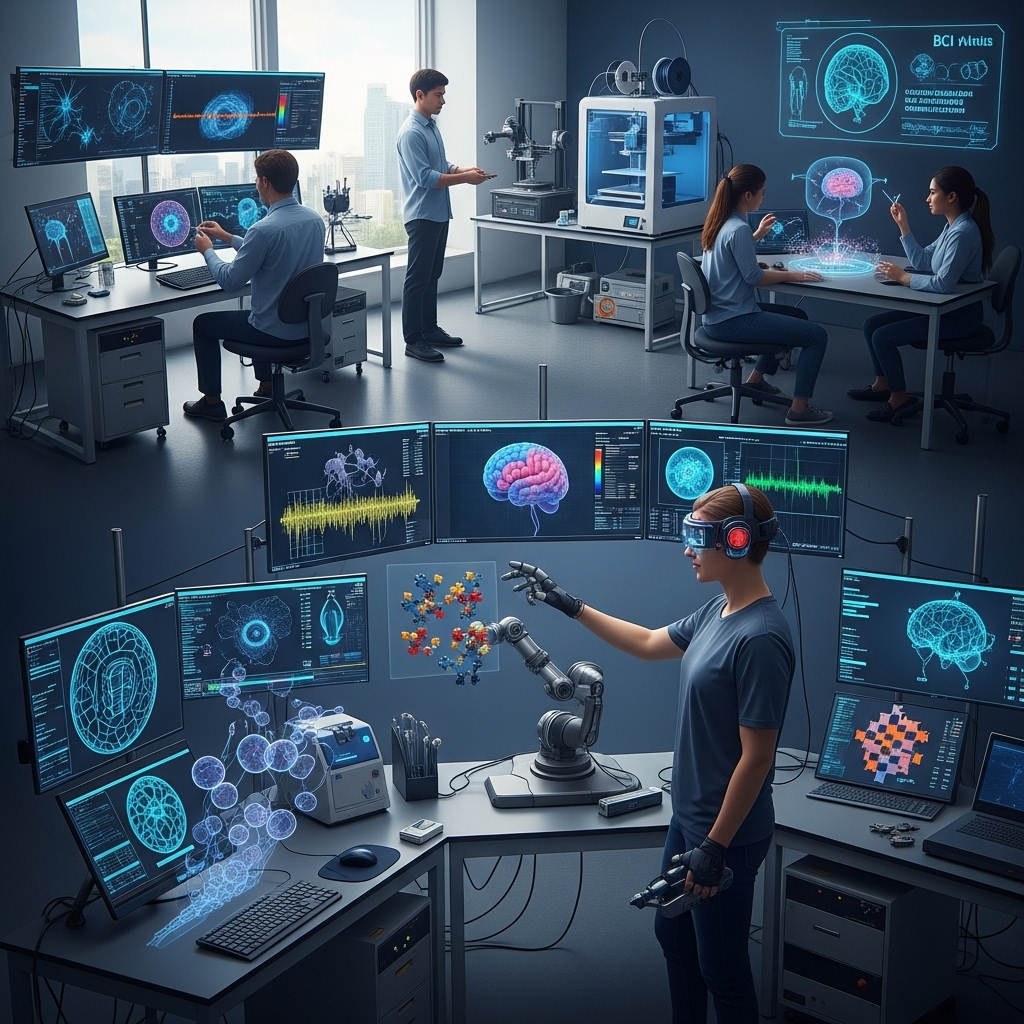
Introduction to Brain-Computer Neural Interfaces
The human brain is a complex and intricate organ, capable of processing vast amounts of information and controlling the body's functions with precision. However, when it comes to interacting with the digital world, we are often limited by the need for manual input devices such as keyboards and mice. Brain-Computer Neural Interfaces (BCIs) aim to revolutionize human connection by enabling people to control devices with their thoughts, potentially transforming the way we interact with technology and each other. In this article, we will delve into the latest advances in BCI projects, exploring their potential applications, benefits, and the future of neural interface technology.
What are Brain-Computer Neural Interfaces?
A Brain-Computer Neural Interface is a system that enables people to control devices or communicate with others using only their brain signals. BCIs work by detecting and interpreting the electrical activity of the brain, typically using electroencephalography (EEG) or other neuroimaging techniques. This information is then translated into commands that can be executed by a computer or other device. BCIs have the potential to restore communication and control to individuals with severe motor disorders, such as paralysis or ALS, and could also enhance human cognition and productivity in various fields, including gaming, education, and healthcare.
Types of Brain-Computer Neural Interfaces
There are several types of BCIs, each with its own strengths and limitations. Invasive BCIs involve implanting electrodes directly into the brain, providing high-resolution signal detection but also carrying significant risks and requiring complex surgery. Partially invasive BCIs, on the other hand, use electrodes implanted in the skull but outside the brain, offering a balance between signal quality and safety. Non-invasive BCIs, which use external sensors to detect brain activity, are the most common and convenient type, but often have lower spatial resolution and signal-to-noise ratios. Examples of non-invasive BCIs include EEG-based headsets and functional near-infrared spectroscopy (fNIRS) devices.
Applications of Brain-Computer Neural Interfaces
The potential applications of BCIs are vast and diverse. In the field of healthcare, BCIs could enable patients with paralysis or other motor disorders to control prosthetic limbs, communicate with caregivers, or even regain some level of independence. In education, BCIs could help students with learning disabilities or attention deficits, providing personalized feedback and adaptive learning strategies. In the gaming industry, BCIs could revolutionize the way we interact with virtual environments, enabling players to control characters and objects with their thoughts. For example, the company Neurable has developed a BCI-powered game controller that allows players to control games with their brain activity, using a non-invasive EEG headset.
Advances in Neural Interface Technology
Recent advances in neural interface technology have led to significant improvements in BCI performance, including higher signal resolution, faster processing speeds, and more sophisticated algorithms for decoding brain activity. One notable example is the development of neural dust, a tiny, implantable sensor that can detect neural activity with high precision and transmit data wirelessly to external devices. Another example is the use of deep learning techniques, such as convolutional neural networks (CNNs) and recurrent neural networks (RNNs), to improve the accuracy and robustness of BCI systems. These advances have paved the way for more complex and intuitive BCI applications, such as controlling robotic arms or communicating through text or speech synthesis.
Challenges and Limitations of Brain-Computer Neural Interfaces
Despite the rapid progress in BCI research, there are still significant challenges and limitations to overcome. One major challenge is the noise and variability of brain signals, which can make it difficult to accurately decode and interpret neural activity. Another challenge is the need for calibration and training, which can be time-consuming and require significant expertise. Additionally, there are concerns about the safety and ethics of BCI technology, particularly with regards to invasive implants and the potential for neural hacking or exploitation. To address these challenges, researchers are working to develop more robust and adaptive BCI systems, as well as guidelines and regulations for the responsible development and use of neural interface technology.
Future of Brain-Computer Neural Interfaces
The future of BCIs holds tremendous promise, with potential applications in fields such as neuroscience, medicine, education, and entertainment. As the technology continues to advance, we can expect to see more sophisticated and intuitive BCI systems, enabling people to control devices and communicate with others in new and innovative ways. For example, the company Neuralink, founded by Elon Musk, is working on a high-bandwidth BCI that could potentially enable people to control computers and other devices with their thoughts, using a implantable neural interface. While there are still significant challenges to overcome, the potential benefits of BCI technology make it an exciting and rapidly evolving field, with the potential to revolutionize human connection and transform the way we interact with the world around us.
Conclusion
In conclusion, Brain-Computer Neural Interfaces have the potential to revolutionize human connection, enabling people to control devices and communicate with others in new and innovative ways. With advances in neural interface technology, including higher signal resolution, faster processing speeds, and more sophisticated algorithms, BCIs are becoming increasingly sophisticated and intuitive. While there are still challenges and limitations to overcome, the potential benefits of BCI technology make it an exciting and rapidly evolving field, with applications in fields such as healthcare, education, and entertainment. As researchers and developers continue to push the boundaries of what is possible with BCIs, we can expect to see significant advancements in the years to come, transforming the way we interact with technology and each other.