
Introduction to Functional Programming
Functional programming is a programming paradigm that has gained significant attention in recent years due to its ability to improve code efficiency, readability, and maintainability. It is a declarative approach to programming, where the focus is on specifying what the program should accomplish, rather than how it should accomplish it. In this article, we will explore the principles of functional programming, its benefits, and real-world applications. We will also discuss how functional programming paradigms can be applied to various programming languages, including JavaScript, Python, and Haskell.
Principles of Functional Programming
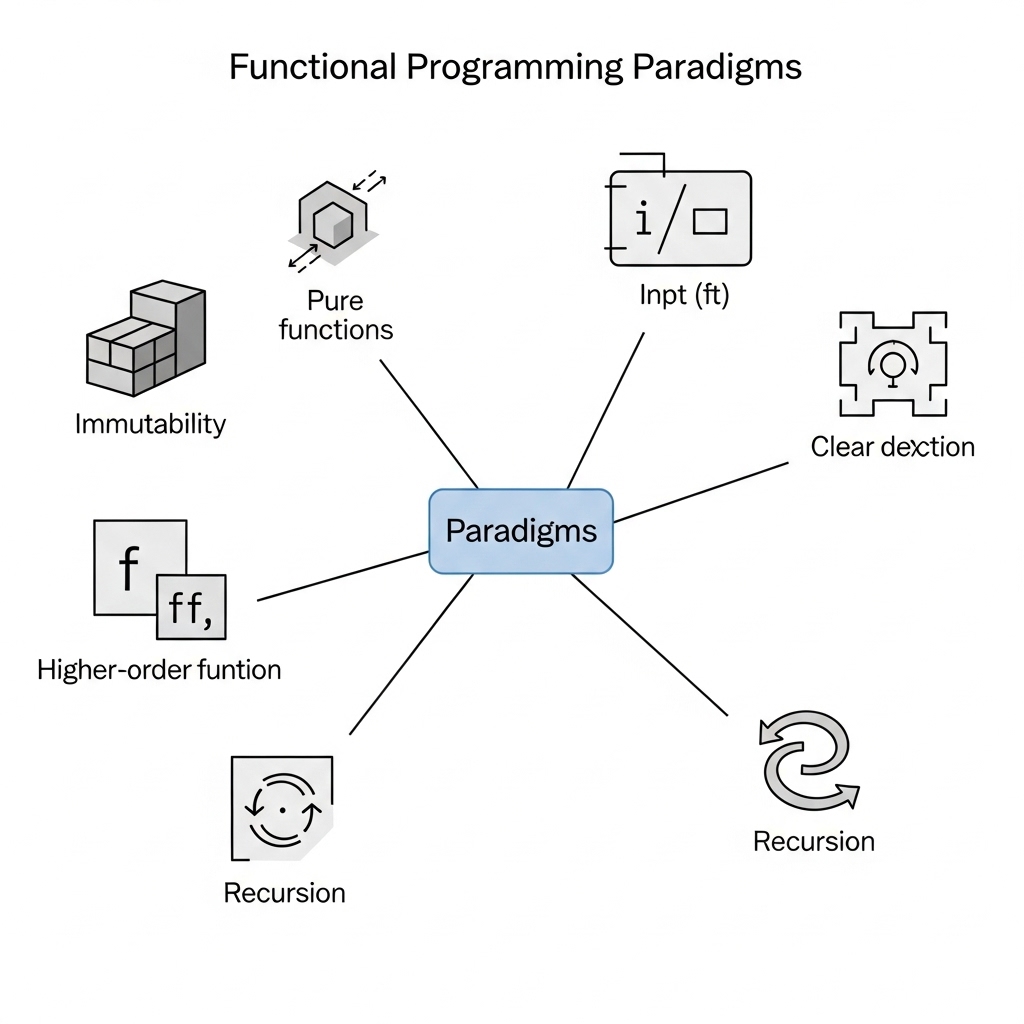
Functional programming is based on several key principles, including immutability, recursion, and higher-order functions. Immutability refers to the idea that data should not be modified in place, but rather new data structures should be created each time the data needs to be updated. Recursion is a programming technique where a function calls itself repeatedly until it reaches a base case. Higher-order functions are functions that take other functions as arguments or return functions as output. These principles enable functional programming to write concise, composable, and reusable code.
For example, in JavaScript, the `map` function is a higher-order function that takes a function as an argument and applies it to each element of an array, returning a new array with the results. This allows for concise and expressive code, such as `numbers.map(x => x * 2)`, which doubles each number in the `numbers` array.
Benefits of Functional Programming
Functional programming offers several benefits, including improved code readability, reduced bugs, and increased productivity. By focusing on what the code should accomplish, rather than how it should accomplish it, functional programming enables developers to write code that is easier to understand and maintain. Additionally, the immutability principle reduces the risk of unintended side effects, making it easier to reason about the code and debug issues.
Functional programming also enables developers to write more composable code, which can be reused in different contexts. This reduces code duplication and makes it easier to modify or extend existing code. For example, a functional programming approach to data processing might involve breaking down a complex operation into smaller, reusable functions, each of which performs a specific task.
Real-World Applications of Functional Programming
Functional programming has a wide range of real-world applications, from data processing and scientific computing to web development and artificial intelligence. In data processing, functional programming can be used to write efficient and scalable data pipelines, using libraries such as Apache Spark or Python's Pandas. In scientific computing, functional programming can be used to write concise and expressive code for numerical simulations, using languages such as Haskell or MATLAB.
In web development, functional programming can be used to write reactive and responsive user interfaces, using libraries such as React or Angular. Functional programming can also be used to write server-side code, using languages such as Node.js or Scala. For example, a functional programming approach to web development might involve using a library like Redux to manage state changes in a web application.
Functional Programming in Different Languages
While functional programming is often associated with languages such as Haskell or Lisp, it can be applied to a wide range of programming languages, including JavaScript, Python, and Java. In JavaScript, functional programming is supported through libraries such as Lodash or Ramda, which provide a range of functional programming utilities, including `map`, `filter`, and `reduce`.
In Python, functional programming is supported through the built-in `map`, `filter`, and `reduce` functions, as well as libraries such as NumPy or Pandas, which provide functional programming interfaces for numerical computing. In Java, functional programming is supported through the Java 8 streams API, which provides a range of functional programming utilities, including `map`, `filter`, and `reduce`.
Best Practices for Functional Programming
To get the most out of functional programming, it's essential to follow best practices, such as writing pure functions, avoiding side effects, and using immutable data structures. Pure functions are functions that always return the same output given the same inputs, without modifying any external state. Avoiding side effects, such as modifying external state or performing I/O operations, makes it easier to reason about the code and debug issues.
Using immutable data structures, such as arrays or objects, reduces the risk of unintended side effects and makes it easier to write composable code. Additionally, using functional programming libraries and utilities, such as `map` or `filter`, can help to write concise and expressive code. For example, a functional programming approach to data processing might involve using a library like Pandas to write efficient and scalable data pipelines.
Conclusion
In conclusion, functional programming is a powerful paradigm that can improve code efficiency, readability, and maintainability. By applying functional programming principles, such as immutability, recursion, and higher-order functions, developers can write concise, composable, and reusable code. Functional programming has a wide range of real-world applications, from data processing and scientific computing to web development and artificial intelligence.
While functional programming may require a different mindset and approach than traditional imperative programming, the benefits are well worth the investment. By following best practices, such as writing pure functions and using immutable data structures, developers can get the most out of functional programming and write more efficient, readable, and maintainable code. Whether you're working in JavaScript, Python, or another language, functional programming is definitely worth exploring.