
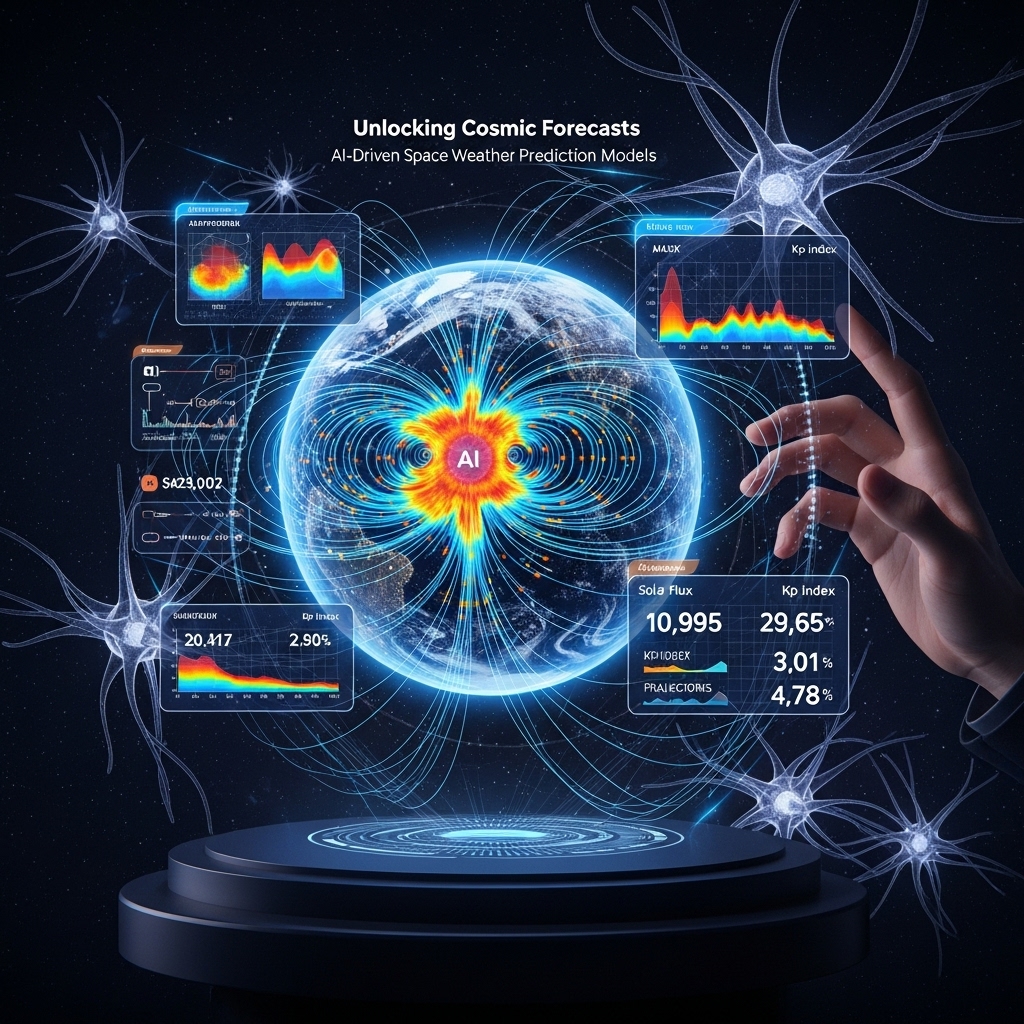
Introduction to AI-Driven Space Weather Prediction
Space weather refers to the dynamic and variable conditions in the space environment that can impact the performance and reliability of space-based technological systems, as well as the safety of both people and electronic systems in space and on the ground. The ability to predict space weather events accurately is crucial for mitigating potential disruptions to satellite operations, communication systems, navigation, and even electrical grids on Earth. Traditional forecasting methods have relied on physical models and empirical relationships, but the integration of Artificial Intelligence (AI) and Machine Learning (ML) is revolutionizing the field by enhancing prediction accuracy and efficiency. This article delves into the realm of AI-driven space weather prediction models, exploring their development, application, and the future of space weather forecasting.
Understanding Space Weather Phenomena
Space weather is influenced by solar activities such as solar flares, coronal mass ejections (CMEs), and high-speed solar winds. These events can cause geomagnetic storms, increases in radiation levels, and disturbances in the ionosphere and magnetosphere, affecting satellite communications, GPS signals, and even airline and astronaut safety. The complexity and variability of these phenomena make accurate prediction challenging. Traditional forecasting relies on observations from spacecraft and ground-based instruments, which provide data on solar and geomagnetic activity. However, these methods have limitations in terms of prediction lead time and accuracy, especially for rare but potentially catastrophic events.
Role of AI in Space Weather Prediction
AI and ML algorithms can analyze vast amounts of data from various sources, including historical records, real-time observations from satellites and ground stations, and simulations. These technologies can identify complex patterns and relationships that may not be apparent through traditional analysis, thereby improving forecast accuracy. For instance, deep learning models like neural networks can be trained on large datasets to predict the likelihood of a geomagnetic storm based on solar wind parameters and geomagnetic indices. Moreover, AI can automate the process of data analysis and prediction, providing timely warnings for space weather events.
Development of AI-Driven Models
The development of AI-driven space weather prediction models involves several steps, including data collection, model training, validation, and deployment. Data collection is critical and involves gathering historical and real-time data from various sources. This data is then used to train ML models, which learn to recognize patterns and make predictions. For example, researchers have used long short-term memory (LSTM) networks to predict the Kp index, a measure of geomagnetic activity, based on solar wind data. Validation of these models against actual events is essential to ensure their accuracy and reliability. Once validated, these models can be deployed in operational environments to provide real-time forecasts.
Applications and Benefits
The applications of AI-driven space weather prediction models are vast and varied. They can be used by space agencies to protect satellites and astronauts from harmful radiation, by airlines to mitigate the effects of geomagnetic storms on navigation and communication systems, and by power grid operators to prevent widespread electrical blackouts. The benefits include enhanced safety, reduced economic losses, and improved efficiency of space-based and ground-based technological systems. For instance, accurate predictions of solar flares can help in the proactive management of satellite orbits and the protection of electronic systems from radiation damage.
Challenges and Future Directions
Despite the advancements in AI-driven space weather prediction, several challenges remain. These include the availability and quality of training data, the complexity of space weather phenomena, and the need for continuous model updates and validation. Future research directions include the integration of multi-source data, the development of more sophisticated AI models, and international collaboration to share data and models. Additionally, there is a growing interest in using AI for predicting the effects of space weather on specific technological systems, such as power grids and communication networks, to enable targeted mitigation strategies.
Conclusion: The Future of Space Weather Forecasting
The integration of AI into space weather prediction represents a significant leap forward in the ability to forecast and prepare for space weather events. As the field continues to evolve, we can expect to see more accurate and detailed forecasts, enabling better protection of space and ground assets. The collaboration between space weather scientists, AI researchers, and stakeholders from affected industries will be crucial in harnessing the full potential of AI-driven models. With ongoing advancements in data collection, model development, and computational power, the future of space weather forecasting looks promising, offering the potential to mitigate the impacts of space weather and ensure the continued safety and efficiency of our technological systems.