
Introduction to Deep-Sea Exploration
The deep sea, a vast and largely unexplored environment, has long fascinated humans. Covering over 70% of the Earth's surface, the ocean's depths are home to unique ecosystems, species, and geological formations that remain a mystery to us. Recent advancements in deep-sea exploration technologies have revolutionized our ability to explore and understand these environments. This article will delve into the latest discoveries and technologies that are unveiling the secrets of the abyss, transforming our understanding of the ocean and its role in the Earth's ecosystem.
Remotely Operated Vehicles (ROVs) and Autonomous Underwater Vehicles (AUVs)
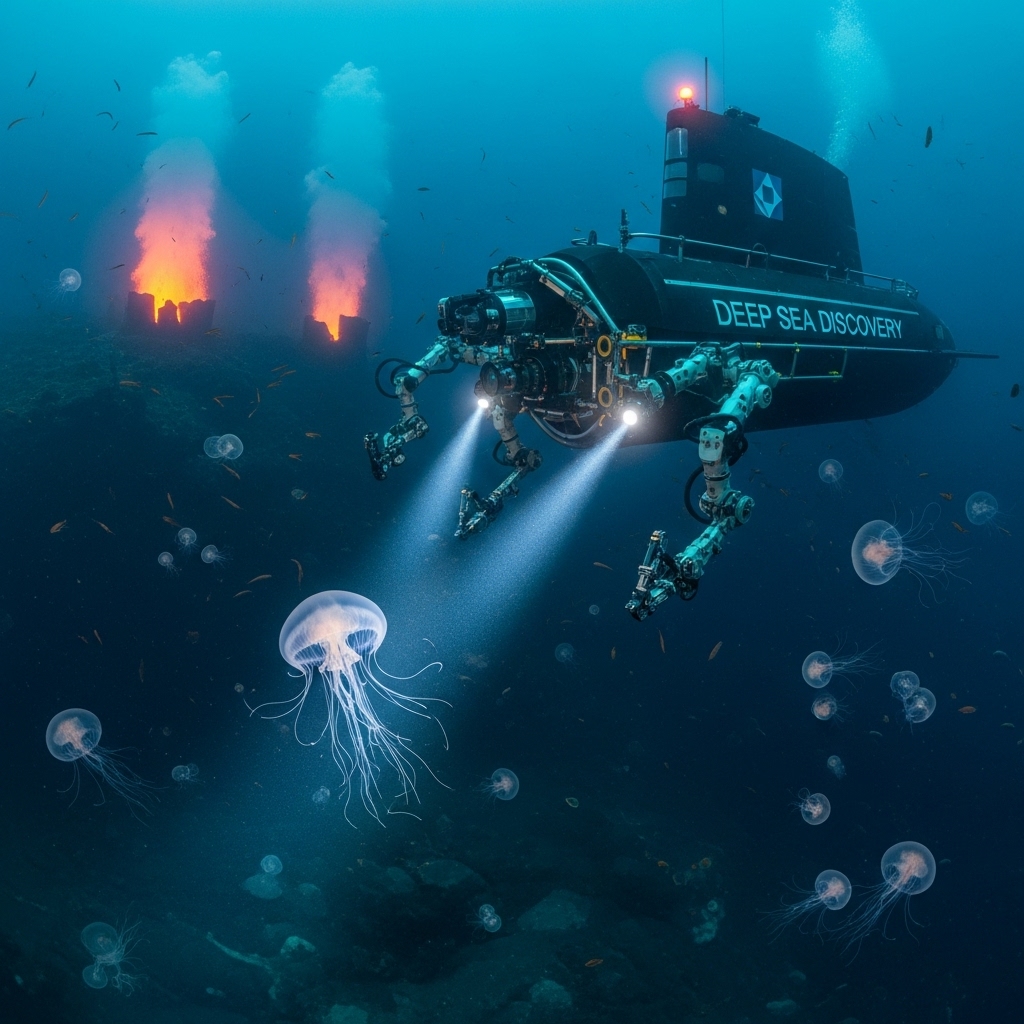
One of the most significant advancements in deep-sea exploration has been the development of Remotely Operated Vehicles (ROVs) and Autonomous Underwater Vehicles (AUVs). These unmanned underwater vehicles are equipped with high-definition cameras, sonar, and manipulator arms, allowing them to collect samples, conduct experiments, and explore the seafloor in real-time. For example, the ROV Deepsea Challenger has been used to explore the Mariana Trench, the deepest point in the ocean, while AUVs like the Bluefin-21 have been used to map the seafloor and detect underwater landslides. These vehicles have greatly expanded our ability to explore the deep sea, reducing the risk to human life and increasing the efficiency of data collection.
Advanced Sonar and Mapping Technologies
Advanced sonar and mapping technologies have also played a crucial role in deep-sea exploration. Multibeam sonar, for instance, uses sound waves to create high-resolution maps of the seafloor, revealing features such as underwater mountains, valleys, and hydrothermal vents. The National Oceanic and Atmospheric Administration (NOAA) has used multibeam sonar to map the seafloor of the Gulf of Mexico, discovering new species and ecosystems. Additionally, technologies like side-scan sonar and sub-bottom profilers have enabled researchers to study the subsurface geology of the ocean floor, providing insights into the Earth's history and the processes that shape our planet.
Deep-Sea Submersibles and Manned Exploration
While ROVs and AUVs have revolutionized deep-sea exploration, manned submersibles still play a vital role in certain types of research. The Alvin submersible, for example, has been used for decades to explore the ocean floor, allowing scientists to collect samples and conduct experiments in person. New submersibles like the Triton 36000/2 are being developed, capable of reaching depths of over 36,000 feet. Manned exploration provides a unique perspective and allows for real-time decision-making, making it an essential tool for certain types of research, such as studying deep-sea ecosystems and geological formations.
Artificial Intelligence and Machine Learning in Deep-Sea Exploration
Artificial intelligence (AI) and machine learning (ML) are being increasingly used in deep-sea exploration to analyze the vast amounts of data collected by ROVs, AUVs, and other technologies. AI-powered algorithms can automatically identify species, detect patterns in ocean currents, and predict the location of underwater features. For example, researchers have used ML to analyze footage from ROVs, identifying new species and habitats that would have been missed by human observers. The integration of AI and ML into deep-sea exploration is transforming our ability to analyze and understand the complex data collected from the ocean floor.
Discoveries and Implications
The discoveries made possible by these technologies have significant implications for our understanding of the ocean and its role in the Earth's ecosystem. The discovery of new species, such as the giant squid and the anglerfish, has expanded our knowledge of the diversity of life on Earth. The exploration of hydrothermal vents has revealed unique ecosystems that thrive in the harsh conditions surrounding these underwater springs, providing insights into the origins of life on Earth. Furthermore, the study of ocean currents and circulation patterns has improved our understanding of climate change and the role of the ocean in regulating the Earth's temperature.
Conclusion and Future Directions
In conclusion, the revolutionary deep-sea exploration technologies and discoveries of recent years have greatly expanded our understanding of the ocean and its role in the Earth's ecosystem. As these technologies continue to evolve, we can expect even more significant discoveries and a deeper understanding of the complex interactions between the ocean, atmosphere, and land. Future directions for deep-sea exploration include the development of more advanced ROVs and AUVs, the integration of AI and ML into data analysis, and the expansion of manned exploration to new depths and regions. As we continue to unveil the secrets of the abyss, we may uncover new insights into the Earth's history, the diversity of life, and the complex systems that govern our planet.