
Introduction to AI Performance Metrics
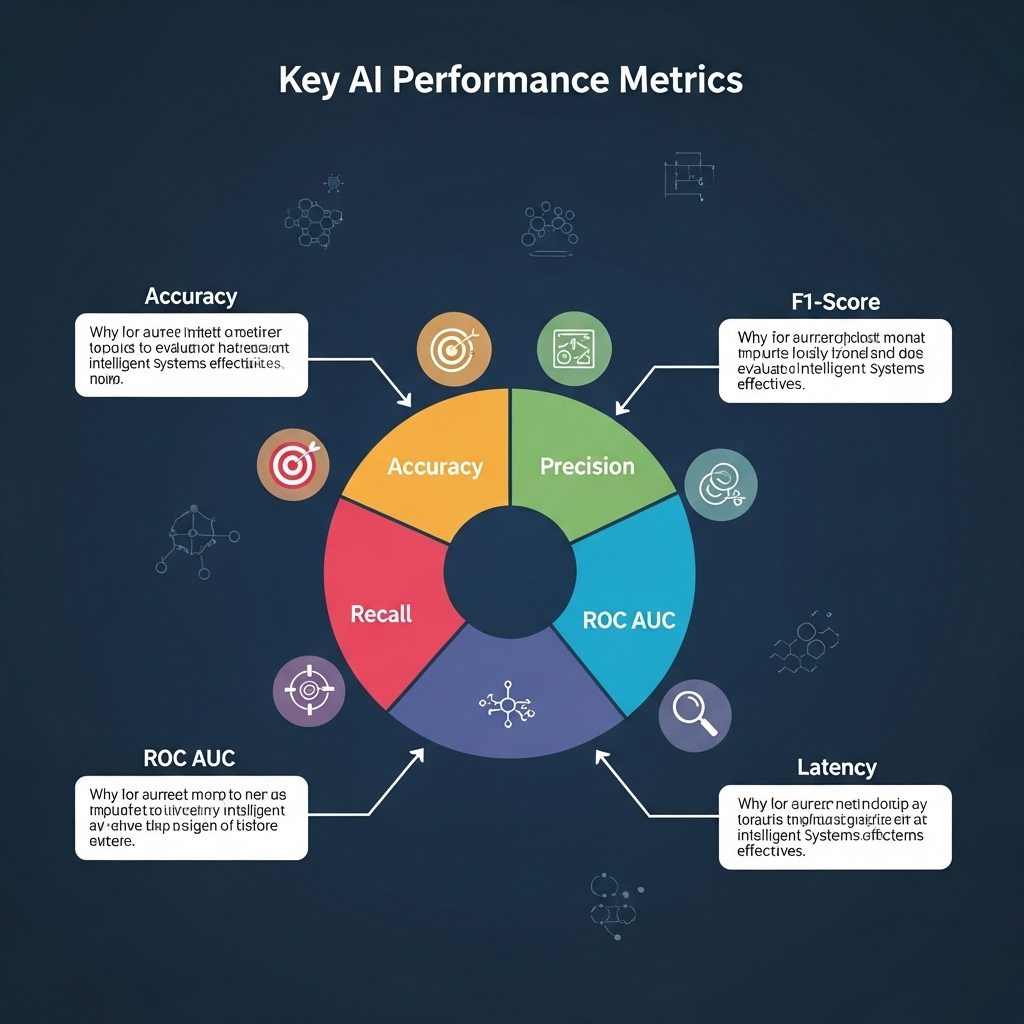
Evaluating the effectiveness of intelligent systems is crucial in determining their ability to perform tasks efficiently and accurately. As AI technology advances, the need for reliable and comprehensive performance metrics has become increasingly important. AI performance metrics are used to assess the capabilities of AI systems, identify areas of improvement, and compare the performance of different models. In this article, we will explore the key performance metrics that matter most for evaluating intelligent systems' effectiveness.
Accuracy and Error Rate
Accuracy and error rate are two fundamental metrics used to evaluate the performance of AI systems. Accuracy measures the proportion of correct predictions or outcomes, while error rate measures the proportion of incorrect predictions or outcomes. For instance, in image classification tasks, accuracy measures the percentage of correctly classified images, while error rate measures the percentage of misclassified images. A lower error rate and higher accuracy indicate better performance. However, it's essential to consider the context and specific use case, as a small error rate may be acceptable in some applications but not in others.
Precision, Recall, and F1 Score
Precision, recall, and F1 score are metrics used to evaluate the performance of AI systems in classification tasks. Precision measures the proportion of true positives among all positive predictions, recall measures the proportion of true positives among all actual positive instances, and F1 score is the harmonic mean of precision and recall. These metrics are essential in evaluating the performance of AI systems in tasks such as sentiment analysis, spam detection, and medical diagnosis. For example, in sentiment analysis, a high precision indicates that the model is good at identifying positive reviews, while a high recall indicates that the model is good at identifying all positive reviews.
Mean Squared Error and Mean Absolute Error
Mean squared error (MSE) and mean absolute error (MAE) are metrics used to evaluate the performance of AI systems in regression tasks. MSE measures the average squared difference between predicted and actual values, while MAE measures the average absolute difference. These metrics are essential in evaluating the performance of AI systems in tasks such as forecasting, recommendation systems, and predictive modeling. For instance, in forecasting, a lower MSE and MAE indicate that the model is better at predicting continuous values.
Computational Resources and Efficiency
Computational resources and efficiency are critical metrics used to evaluate the performance of AI systems. These metrics include processing time, memory usage, and energy consumption. As AI models become increasingly complex, they require significant computational resources, which can impact their deployment and scalability. Evaluating the computational resources and efficiency of AI systems is essential in determining their feasibility for real-world applications. For example, a model that requires significant computational resources may not be suitable for deployment on edge devices or in real-time applications.
Explainability and Transparency
Explainability and transparency are essential metrics used to evaluate the performance of AI systems. These metrics measure the ability of AI systems to provide insights into their decision-making processes and outcomes. Explainability and transparency are critical in applications such as healthcare, finance, and law, where the consequences of incorrect decisions can be severe. Techniques such as feature importance, partial dependence plots, and SHAP values can be used to evaluate the explainability and transparency of AI systems.
Conclusion
In conclusion, evaluating the effectiveness of intelligent systems requires a comprehensive set of performance metrics. Accuracy, error rate, precision, recall, F1 score, mean squared error, mean absolute error, computational resources, efficiency, explainability, and transparency are some of the key metrics that matter most. By considering these metrics, developers and practitioners can identify areas of improvement, compare the performance of different models, and deploy AI systems that are efficient, effective, and reliable. As AI technology continues to evolve, the development of new performance metrics and evaluation techniques will be crucial in ensuring that AI systems meet the required standards of performance and trustworthiness.