
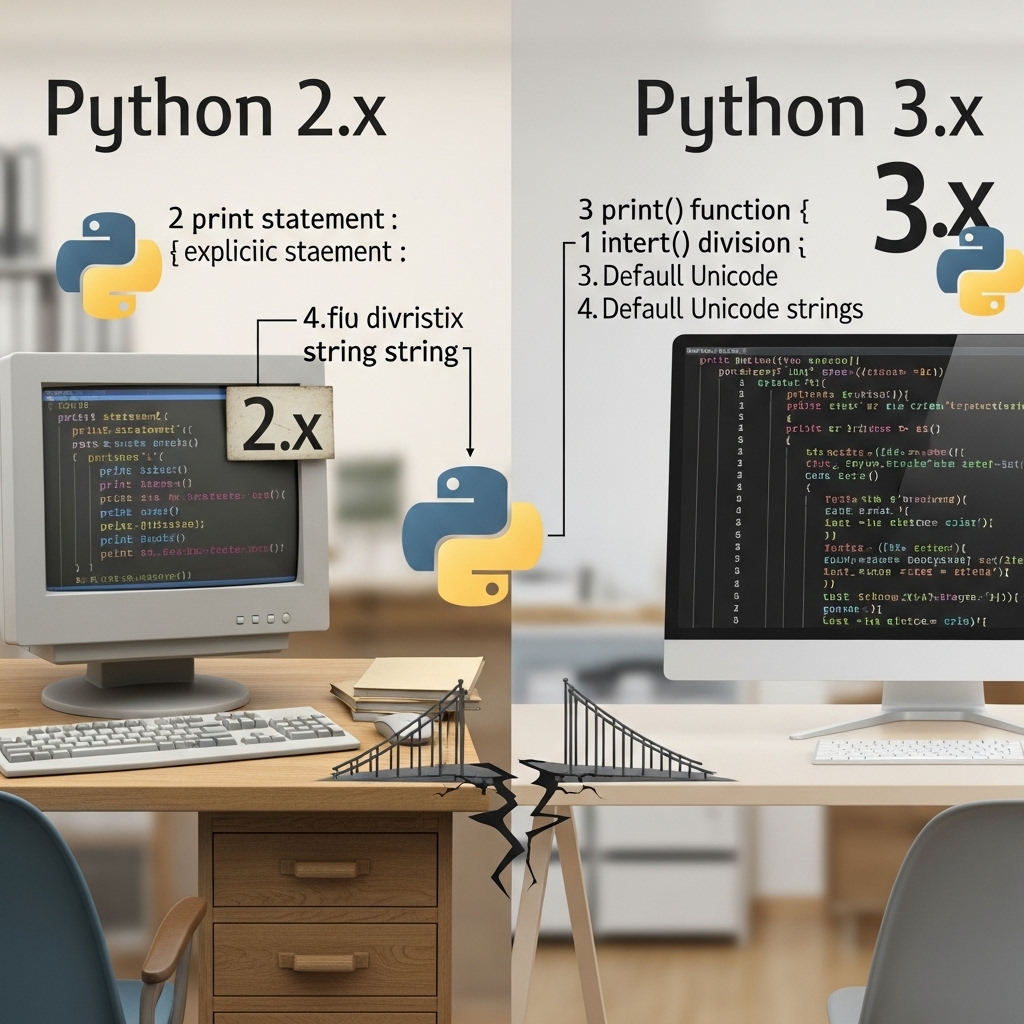
Introduction to Python 2.x and 3.x Frameworks
The Python programming language has undergone significant changes since its inception, with the most notable being the transition from Python 2.x to Python 3.x. This shift has introduced numerous modifications to the language's syntax, standard library, and overall ecosystem. As a result, developers must be aware of the key differences between Python 2.x and 3.x frameworks to ensure compatibility, efficiency, and effective coding practices. In this article, we will delve into the primary distinctions between these two versions, exploring their implications on development, performance, and the Python ecosystem as a whole.
Syntax and Semantic Changes
One of the most apparent differences between Python 2.x and 3.x is the syntax and semantic changes. Python 3.x introduces a more rigorous and consistent syntax, addressing some of the ambiguities and flaws present in Python 2.x. For instance, the print statement, which was a statement in Python 2.x, is now a function in Python 3.x. This change requires developers to use parentheses when printing output, as seen in the example: print("Hello, World!"). Additionally, the handling of integer division has changed, with Python 3.x performing "true division" by default, whereas Python 2.x performed integer division when both operands were integers.
Unicode Support and Encoding
Python 3.x boasts improved Unicode support and encoding, making it a more versatile and internationalized language. In Python 2.x, the default encoding was ASCII, which often led to issues when working with non-ASCII characters. In contrast, Python 3.x uses UTF-8 as the default encoding, allowing for seamless handling of Unicode characters. This change is particularly significant when working with text data, as it eliminates the need for manual encoding and decoding. The following example illustrates the difference: python2: "ä".encode("utf-8") versus python3: "ä".encode().
Standard Library and Module Changes
The standard library in Python 3.x has undergone significant changes, with some modules being renamed, removed, or replaced. For example, the httplib module in Python 2.x has been renamed to http.client in Python 3.x. Similarly, the SocketServer module has been renamed to socketserver. These changes require developers to update their import statements and module usage accordingly. Furthermore, some modules, such as md5 and sha, have been moved to the hashlib module in Python 3.x.
Performance and Optimization
Python 3.x has introduced various performance enhancements and optimizations, making it a more efficient language than its predecessor. One notable improvement is the use of a new memory management system, which reduces memory fragmentation and improves overall performance. Additionally, Python 3.x features a revamped io module, which provides faster and more efficient I/O operations. The following benchmark demonstrates the performance difference: python2: timeit.timeit("x = [1] * 1000000") versus python3: timeit.timeit("x = [1] * 1000000"), with Python 3.x showing a significant improvement.
Backwards Compatibility and Migration
Despite the numerous changes between Python 2.x and 3.x, the Python community has made efforts to ensure backwards compatibility and provide tools for migration. The 2to3 tool, for example, can automatically convert Python 2.x code to Python 3.x, addressing many of the syntax and semantic changes. Additionally, libraries like six and future provide a way to write code that is compatible with both Python 2.x and 3.x, making it easier to maintain and migrate existing codebases.
Conclusion
In conclusion, the differences between Python 2.x and 3.x frameworks are significant, and understanding these changes is crucial for developers working with the Python ecosystem. By acknowledging the syntax and semantic changes, Unicode support and encoding, standard library and module changes, performance and optimization, and backwards compatibility and migration tools, developers can ensure their code is compatible, efficient, and effective. As the Python community continues to evolve and improve, it is essential to stay up-to-date with the latest developments and best practices, ultimately leading to better software development and a more robust Python ecosystem.