
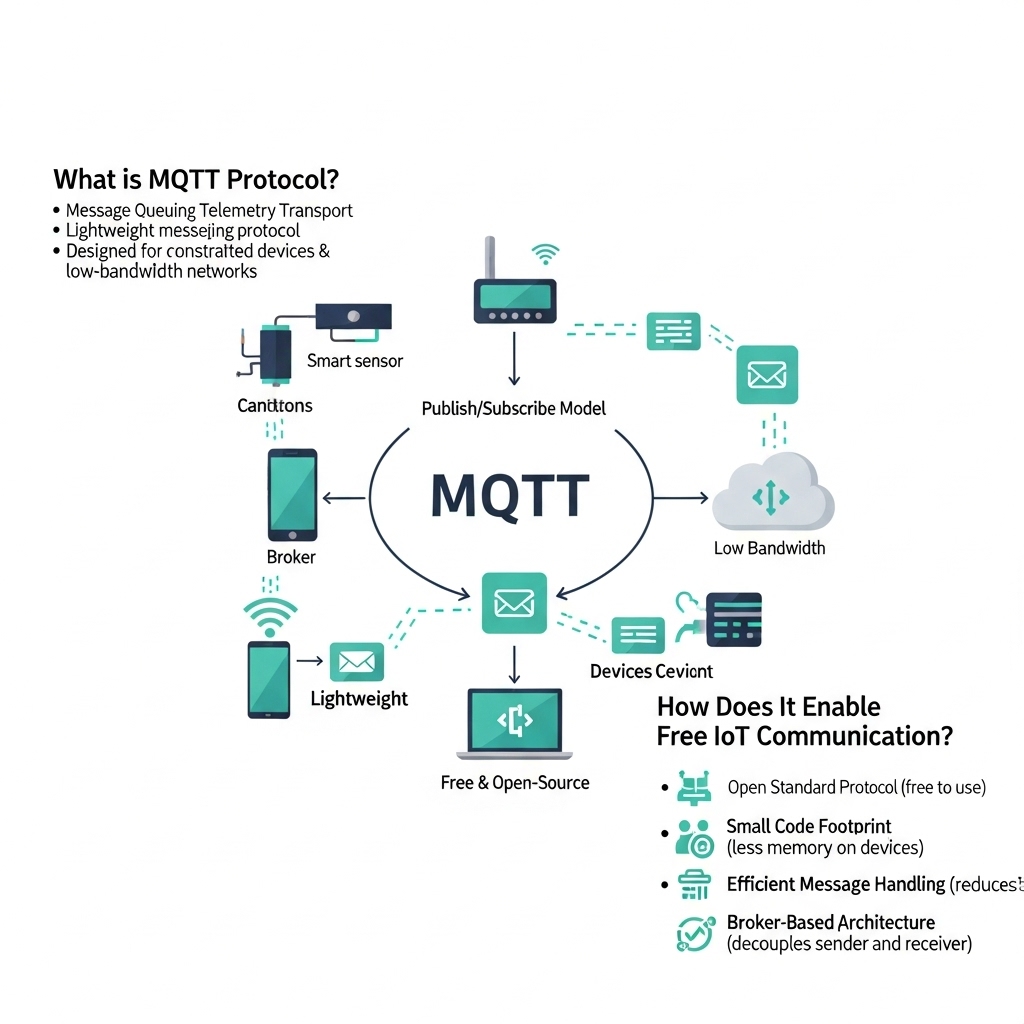
Introduction to MQTT Protocol
The Internet of Things (IoT) has revolutionized the way devices interact with each other and their environment. One of the key technologies that enable this interaction is the MQTT protocol. MQTT, which stands for Message Queuing Telemetry Transport, is a lightweight messaging protocol that allows devices to communicate with each other efficiently and reliably. In this article, we will explore what MQTT protocol is, how it works, and its role in enabling free IoT communication.
What is MQTT Protocol?
MQTT is a publish-subscribe-based messaging protocol that allows devices to send and receive messages. It was designed to be lightweight and efficient, making it suitable for use in resource-constrained devices such as sensors, actuators, and other IoT devices. MQTT uses a broker-based architecture, where devices connect to a central broker that manages the communication between devices. The broker is responsible for forwarding messages from publishers to subscribers.
MQTT protocol is based on the TCP/IP protocol and uses a simple and compact message format. It supports three types of messages: CONNECT, PUBLISH, and SUBSCRIBE. The CONNECT message is used to establish a connection between a device and the broker, while the PUBLISH message is used to send data from a device to the broker. The SUBSCRIBE message is used to subscribe to a particular topic, which allows devices to receive messages published to that topic.
How Does MQTT Protocol Work?
The MQTT protocol works as follows: a device connects to an MQTT broker using the CONNECT message. Once connected, the device can publish messages to a particular topic using the PUBLISH message. Other devices that are subscribed to the same topic will receive the message from the broker. The broker is responsible for managing the topics and forwarding messages to the correct devices.
For example, consider a smart home system where a temperature sensor publishes its readings to the topic "home/temperature". A thermostat that is subscribed to this topic will receive the temperature readings and adjust the heating or cooling system accordingly. This is just one example of how MQTT protocol enables IoT communication.
Advantages of MQTT Protocol
MQTT protocol has several advantages that make it a popular choice for IoT communication. Some of the key advantages include:
Low bandwidth usage: MQTT protocol uses a compact message format, which reduces the amount of bandwidth required for communication. This makes it suitable for use in applications where bandwidth is limited.
Low power consumption: MQTT protocol is designed to be energy-efficient, making it suitable for use in battery-powered devices.
Reliability: MQTT protocol provides guaranteed delivery of messages, which ensures that critical data is not lost.
Scalability: MQTT protocol can handle a large number of devices and messages, making it suitable for large-scale IoT applications.
MQTT Protocol in IoT Applications
MQTT protocol is widely used in various IoT applications, including:
Smart homes and buildings: MQTT protocol is used to control and monitor lighting, temperature, and security systems.
Industrial automation: MQTT protocol is used to monitor and control industrial equipment, such as sensors, actuators, and machines.
Transportation systems: MQTT protocol is used in vehicle-to-vehicle and vehicle-to-infrastructure communication.
Healthcare: MQTT protocol is used in medical devices, such as patient monitors and insulin pumps.
Free MQTT Brokers and Clients
There are several free MQTT brokers and clients available that can be used for IoT development and testing. Some popular options include:
Mosquitto: Mosquitto is a popular open-source MQTT broker that can be used on a variety of platforms, including Windows, Linux, and macOS.
Eclipse Paho: Eclipse Paho is a set of open-source MQTT clients that can be used on a variety of platforms, including Android, iOS, and Linux.
HiveMQ: HiveMQ is a commercial MQTT broker that offers a free trial version.
Conclusion
In conclusion, MQTT protocol is a lightweight and efficient messaging protocol that enables free IoT communication. Its publish-subscribe-based architecture and compact message format make it suitable for use in resource-constrained devices. MQTT protocol has several advantages, including low bandwidth usage, low power consumption, reliability, and scalability. It is widely used in various IoT applications, including smart homes and buildings, industrial automation, transportation systems, and healthcare. With several free MQTT brokers and clients available, developers can easily get started with IoT development and testing.