
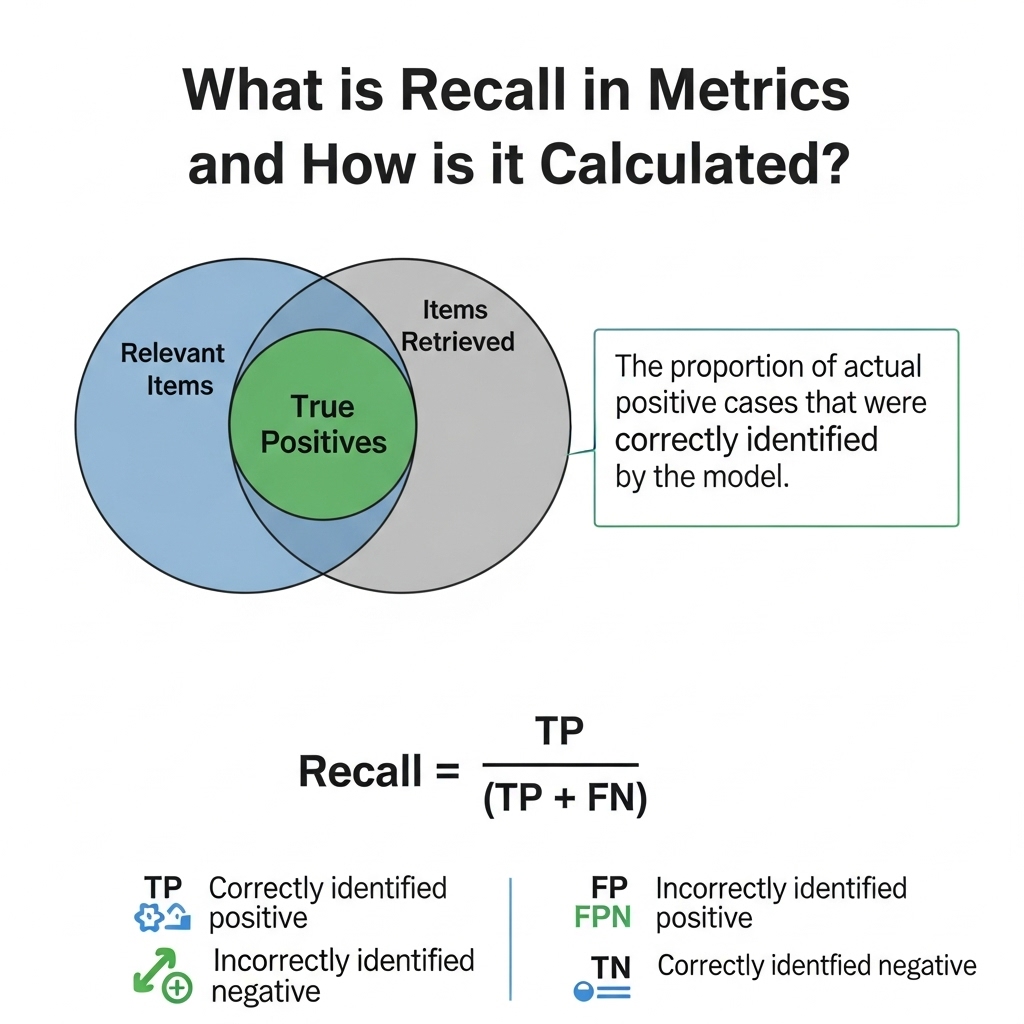
Introduction to Recall in Metrics
Recall is a fundamental metric used in various fields, including information retrieval, machine learning, and data analysis. It measures the proportion of relevant instances that are correctly identified by a model or system. In other words, recall calculates the number of true positives (correctly identified instances) out of all actual positive instances. Understanding recall is crucial in evaluating the performance of a model, as it provides insight into its ability to detect relevant information. In this article, we will delve into the concept of recall, its calculation, and its applications.
Definition and Formula
Recall is defined as the ratio of true positives (TP) to the sum of true positives and false negatives (FN). The formula for recall is: Recall = TP / (TP + FN). This formula indicates that recall is sensitive to the number of false negatives, which are instances that are not identified by the model but are actually relevant. A high recall value indicates that the model is effective in identifying most of the relevant instances, while a low recall value suggests that the model is missing many relevant instances.
Example and Calculation
To illustrate the calculation of recall, consider a simple example. Suppose we have a spam filter that aims to identify spam emails. Out of 100 emails, 60 are spam and 40 are not. The spam filter correctly identifies 50 spam emails (TP = 50) and misses 10 spam emails (FN = 10). Using the recall formula, we can calculate the recall as follows: Recall = 50 / (50 + 10) = 50 / 60 = 0.83 or 83%. This means that the spam filter has a recall of 83%, indicating that it correctly identifies 83% of the actual spam emails.
Importance of Recall in Evaluation
Recall is a critical metric in evaluating the performance of a model, especially in applications where missing relevant information can have significant consequences. For instance, in medical diagnosis, a model with high recall is essential to ensure that most patients with a disease are correctly diagnosed. Similarly, in search engines, high recall is crucial to retrieve most of the relevant documents for a given query. A model with low recall may lead to missed opportunities, incorrect conclusions, or poor decision-making.
Relationship with Precision
Recall is often used in conjunction with another metric, precision, to provide a comprehensive evaluation of a model. Precision measures the proportion of true positives among all predicted positive instances. While recall focuses on detecting all relevant instances, precision focuses on avoiding false positives. The relationship between recall and precision is inverse, meaning that increasing recall often leads to decreasing precision, and vice versa. A model with high recall may have low precision, indicating that it identifies many relevant instances but also includes many false positives.
Applications and Use Cases
Recall has numerous applications in various fields, including information retrieval, natural language processing, and computer vision. In information retrieval, recall is used to evaluate the effectiveness of search engines, recommender systems, and text classification models. In natural language processing, recall is used to evaluate the performance of sentiment analysis, named entity recognition, and machine translation models. In computer vision, recall is used to evaluate the performance of object detection, image classification, and segmentation models.
Conclusion
In conclusion, recall is a vital metric in evaluating the performance of a model, particularly in applications where detecting relevant information is crucial. Understanding recall and its calculation is essential in assessing the effectiveness of a model in identifying true positives and avoiding false negatives. By considering recall in conjunction with precision, we can gain a comprehensive understanding of a model's strengths and weaknesses, ultimately leading to improved model development and decision-making. As the use of machine learning and data analysis continues to grow, the importance of recall as a metric will only continue to increase, making it a fundamental concept in the field of data science.