
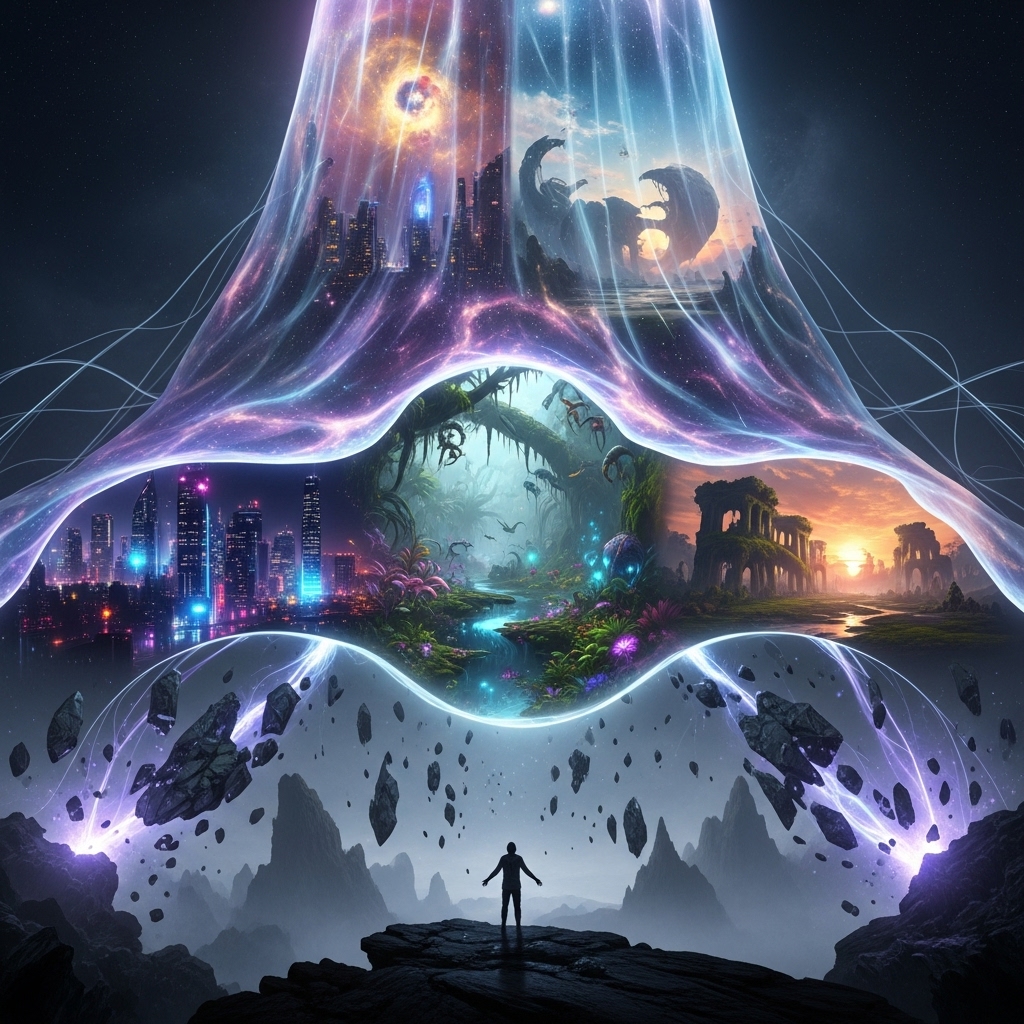
Introduction to Parallel Universes
The concept of parallel universes has long fascinated scientists, philosophers, and science fiction writers alike. The idea that there may be multiple universes beyond our own, each with its own unique version of reality, is a mind-boggling one that challenges our understanding of space, time, and the fundamental laws of physics. In this article, we will delve into the mysteries of parallel universes, exploring the theories, evidence, and implications of these alternate realities.
Understanding the Multiverse Hypothesis
The multiverse hypothesis proposes that our universe is just one of many, possibly infinite, universes that exist in a vast multidimensional space. Each universe within the multiverse may have its own unique set of physical laws, constants, and properties, giving rise to diverse realities that may be similar or vastly different from our own. The multiverse hypothesis is supported by various theories, including eternal inflation, string theory, and the many-worlds interpretation of quantum mechanics.
For example, the many-worlds interpretation suggests that every time a quantum event occurs, the universe splits into multiple parallel universes, each with a different outcome. This would result in an exponential proliferation of universes, with an infinite number of parallel realities emerging from every quantum event.
Types of Parallel Universes
There are several types of parallel universes that have been proposed, each with its own unique characteristics and properties. These include: braneworld universes, which exist in a higher-dimensional space called the "bulk"; mirror universes, which are identical to our own but with opposite properties; and simulated universes, which are created by advanced civilizations for entertainment or research purposes.
Another type of parallel universe is the concept of the "echo universe," which proposes that our universe is surrounded by a series of parallel universes that are identical to our own but with slight variations. These echo universes could be thought of as "echoes" of our own universe, with the same physical laws and constants but with different initial conditions.
Evidence for Parallel Universes
While there is currently no direct empirical evidence for parallel universes, there are several indirect hints and observations that suggest the possibility of their existence. For example, the observation of gravitational waves by the Laser Interferometer Gravitational-Wave Observatory (LIGO) has provided evidence for the existence of extra dimensions, which could be indicative of parallel universes.
Additionally, the phenomenon of quantum entanglement, where particles become connected and can affect each other even at vast distances, could be evidence of interactions between parallel universes. Some theories suggest that entanglement could be a result of particles "leaking" between parallel universes, allowing for the transfer of information and energy between them.
Implications of Parallel Universes
The concept of parallel universes has far-reaching implications for our understanding of reality and the nature of existence. If parallel universes exist, it would suggest that every possibility exists in some universe or other, and that every decision or event creates a new universe with a different outcome.
This raises questions about the concept of free will and the nature of reality. If every possibility exists in some universe, do we really have control over our choices, or are they predetermined by the existence of parallel universes? The implications of parallel universes also challenge our understanding of time and space, suggesting that these concepts may be more fluid and flexible than we currently understand.
Exploring Parallel Universes
While we currently have no way of directly observing or interacting with parallel universes, there are several theories and proposals for how we might explore or communicate with them. For example, some scientists have proposed the use of wormholes, which could potentially connect two parallel universes and allow for the transfer of information and matter between them.
Other proposals involve the use of quantum entanglement and other quantum phenomena to communicate with parallel universes. However, these ideas are still highly speculative and require further research and development to determine their feasibility.
Conclusion
In conclusion, the concept of parallel universes is a fascinating and complex one that challenges our understanding of reality and the nature of existence. While there is currently no direct evidence for parallel universes, the multiverse hypothesis and various theories and observations provide indirect hints and suggestions of their possible existence.
As our understanding of the universe and the laws of physics continues to evolve, we may uncover more evidence for parallel universes and develop new ways to explore and interact with them. The implications of parallel universes are far-reaching and profound, challenging our understanding of time, space, and the nature of reality itself. Ultimately, the concept of parallel universes invites us to think creatively and imaginatively about the possibilities that lie beyond the veil of our everyday reality.