
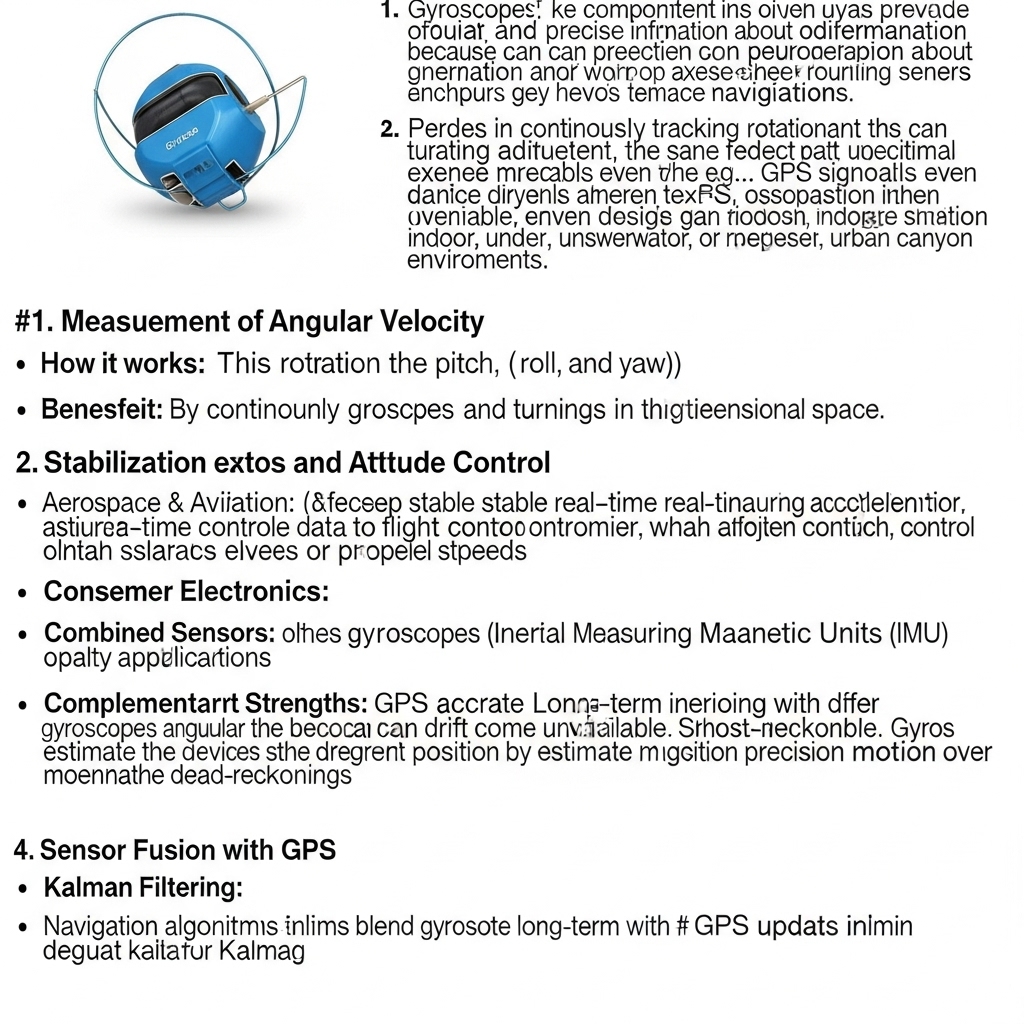
Introduction to Gyroscopes in Navigation
A gyroscope is a device that measures the orientation and angular velocity of an object. It has been a crucial component in navigation systems for decades, providing accurate and reliable data to guide vehicles, aircraft, and other moving objects. In modern technology, gyroscopes play an even more significant role, enhancing navigation systems in various ways. This article will explore how gyroscopes work and how they improve navigation systems in different fields.
Principle of Gyroscopes
A gyroscope consists of a spinning wheel or disc that is mounted on a set of gimbals. The gimbals allow the wheel to rotate freely in any direction, and the spin of the wheel creates a gyroscopic effect. This effect causes the wheel to maintain its orientation in space, even when the surrounding environment changes. By measuring the orientation and angular velocity of the wheel, a gyroscope can determine the orientation and rotation of the object it is attached to. This data is then used to calculate the object's position, velocity, and acceleration.
Applications of Gyroscopes in Navigation
Gyroscopes are used in various navigation systems, including inertial navigation systems (INS), global positioning systems (GPS), and attitude and heading reference systems (AHRS). In INS, gyroscopes are used to measure the acceleration and rotation of a vehicle, allowing it to calculate its position and velocity. In GPS, gyroscopes are used to improve the accuracy of location data by providing additional information about the vehicle's orientation and movement. In AHRS, gyroscopes are used to determine the orientation and heading of an aircraft or vehicle, allowing it to maintain a stable course.
Enhancements to Navigation Systems
Gyroscopes enhance navigation systems in several ways. Firstly, they provide high-accuracy data about an object's orientation and rotation, allowing for more precise calculations of its position and velocity. Secondly, gyroscopes can operate in environments where other navigation systems, such as GPS, are unavailable or unreliable. For example, in tunnels or underwater, gyroscopes can provide accurate navigation data even when GPS signals are blocked. Thirdly, gyroscopes can be used to improve the stability and control of vehicles, such as aircraft and drones, by providing real-time data about their orientation and movement.
Examples of Gyroscope-Based Navigation
There are many examples of gyroscope-based navigation in modern technology. In the aviation industry, gyroscopes are used in flight control systems to stabilize aircraft and provide accurate navigation data. In the automotive industry, gyroscopes are used in advanced driver-assistance systems (ADAS) to improve vehicle stability and control. In the field of robotics, gyroscopes are used to navigate and control autonomous vehicles, such as self-driving cars and drones. For instance, the navigation system of the Mars Curiosity Rover relies on a gyroscope to maintain its orientation and direction on the Martian surface.
Advantages and Limitations of Gyroscopes
Gyroscopes have several advantages, including high accuracy, reliability, and versatility. They can operate in a wide range of environments and can provide data at high speeds. However, gyroscopes also have some limitations. They can be affected by external factors, such as temperature and vibration, which can reduce their accuracy. Additionally, gyroscopes require regular calibration and maintenance to ensure their accuracy and reliability. Despite these limitations, gyroscopes remain a crucial component in modern navigation systems, and their advantages make them an essential tool in many industries.
Conclusion
In conclusion, gyroscopes play a vital role in enhancing navigation systems in modern technology. Their high-accuracy data and versatility make them an essential component in various navigation systems, including INS, GPS, and AHRS. By providing accurate and reliable data about an object's orientation and rotation, gyroscopes improve the stability and control of vehicles, and enable them to navigate complex environments. As technology continues to evolve, the importance of gyroscopes in navigation systems will only continue to grow, and their applications will expand into new fields, such as autonomous vehicles and robotics.