
Introduction
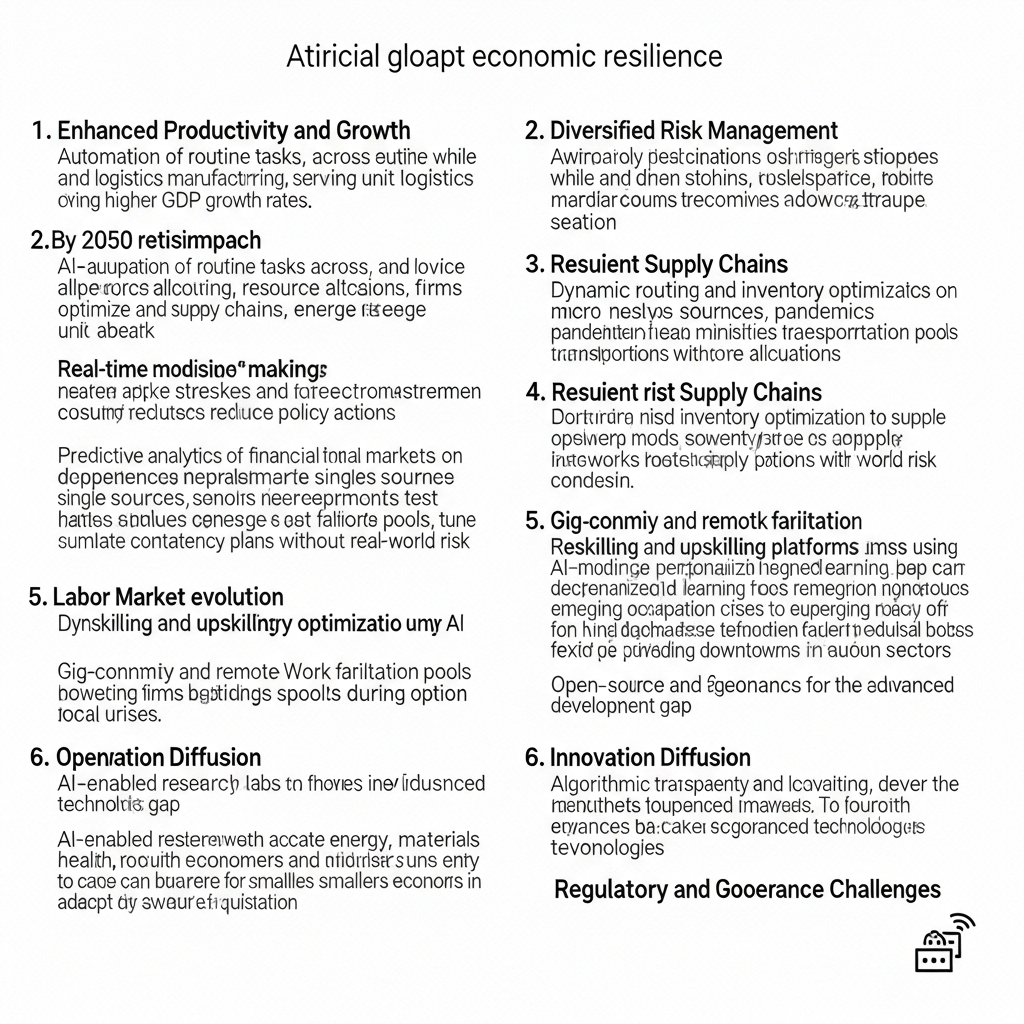
As the world grapples with the challenges of the 21st century, from climate change to economic inequality, the role of artificial intelligence (AI) in shaping global economic resilience is becoming increasingly important. By 2050, AI is expected to have a profound impact on the global economy, transforming industries, and revolutionizing the way we live and work. In this article, we will explore the potential impact of AI on global economic resilience, examining both the opportunities and challenges that lie ahead.
The Current State of AI and Economic Resilience
AI is already being used in various sectors, from finance and healthcare to transportation and education. Its applications range from chatbots and virtual assistants to predictive analytics and machine learning algorithms. While AI has the potential to bring about significant economic benefits, such as increased productivity and efficiency, it also poses risks, including job displacement and increased inequality. Understanding the current state of AI and its impact on economic resilience is crucial for preparing for the challenges and opportunities that lie ahead.
For example, a study by the McKinsey Global Institute found that AI could increase global GDP by up to 14% by 2030, but it could also displace up to 800 million jobs. This highlights the need for policymakers and business leaders to develop strategies that mitigate the negative impacts of AI while maximizing its benefits.
Opportunities for Economic Growth and Development
AI has the potential to drive economic growth and development in several ways. Firstly, it can increase productivity by automating routine and repetitive tasks, freeing up human workers to focus on more complex and creative tasks. Secondly, AI can improve decision-making by providing insights and predictions based on large datasets. Finally, AI can enable the development of new industries and business models, such as the sharing economy and the Internet of Things (IoT).
For instance, in the healthcare sector, AI can help diagnose diseases more accurately and quickly, leading to better patient outcomes and reduced healthcare costs. In the finance sector, AI can help detect and prevent financial crimes, such as money laundering and fraud. These are just a few examples of the many opportunities that AI presents for economic growth and development.
Challenges to Economic Resilience
While AI presents many opportunities, it also poses significant challenges to economic resilience. One of the main challenges is job displacement, as AI automates jobs that were previously done by humans. This could lead to significant unemployment and social unrest, particularly in industries where workers do not have the skills to adapt to an AI-driven economy.
Another challenge is the potential for AI to exacerbate existing inequalities. For example, if AI is primarily developed and controlled by a small elite, it could lead to a concentration of wealth and power, further marginalizing already disadvantaged groups. Furthermore, AI could also be used to manipulate and control people, undermining democratic institutions and human rights.
Building Resilience in an AI-Driven Economy
To build resilience in an AI-driven economy, policymakers and business leaders must develop strategies that address the challenges posed by AI. This includes investing in education and retraining programs that help workers develop the skills they need to thrive in an AI-driven economy. It also includes implementing policies that protect workers' rights and prevent the exploitation of AI for malicious purposes.
For example, governments could establish regulations that require companies to disclose their use of AI and ensure that AI systems are transparent and accountable. They could also invest in initiatives that promote diversity and inclusion in the development of AI, ensuring that AI systems are fair and unbiased.
Conclusion
In conclusion, the impact of AI on global economic resilience by 2050 will be significant. While AI presents many opportunities for economic growth and development, it also poses challenges that must be addressed. By understanding the current state of AI and its potential impacts, policymakers and business leaders can develop strategies that maximize the benefits of AI while minimizing its risks. This includes investing in education and retraining programs, implementing policies that protect workers' rights, and promoting diversity and inclusion in the development of AI.
Ultimately, building resilience in an AI-driven economy will require a collaborative effort from governments, businesses, and civil society. By working together, we can ensure that AI is developed and used in ways that promote economic growth, social justice, and human well-being. As we look to the future, it is clear that AI will play a major role in shaping the global economy, and it is up to us to ensure that its impact is positive and beneficial for all.