
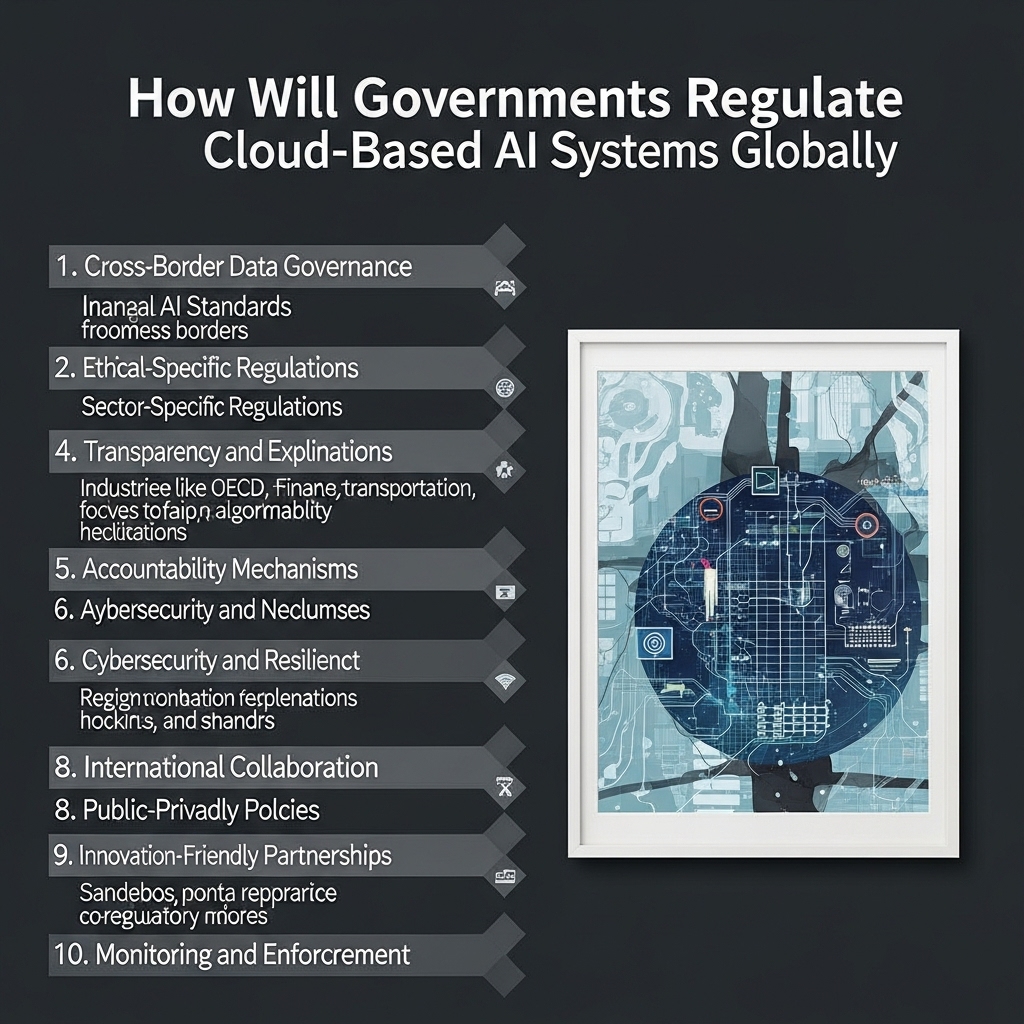
Introduction to Cloud-Based AI Regulation
The rapid growth of cloud-based AI systems has transformed the way businesses and governments operate, offering unparalleled scalability, flexibility, and cost savings. However, this growth also raises significant regulatory challenges, as these systems often transcend national borders and jurisdictions. Governments worldwide are grappling with how to regulate cloud-based AI systems, balancing the need to promote innovation with the need to protect citizens' rights and ensure public safety. In this article, we will explore the current state of cloud-based AI regulation and how governments are likely to approach this complex issue in the future.
Current State of Cloud-Based AI Regulation
Currently, there is no unified global framework for regulating cloud-based AI systems. Instead, countries have developed their own regulations, which can be inconsistent and sometimes conflicting. For example, the European Union's General Data Protection Regulation (GDPR) imposes strict data protection requirements on companies operating in the EU, while the United States has a more permissive approach to data protection. This patchwork of regulations can create uncertainty and compliance challenges for companies operating globally. Furthermore, the lack of standardization can hinder the development of cloud-based AI systems, as companies may need to tailor their systems to meet different regulatory requirements in each country.
Key Challenges in Regulating Cloud-Based AI Systems
Regulating cloud-based AI systems poses several challenges. One of the primary challenges is the complexity of these systems, which often involve multiple stakeholders, including cloud service providers, AI developers, and end-users. Additionally, cloud-based AI systems can process vast amounts of personal data, raising concerns about data protection and privacy. Another challenge is the rapid evolution of AI technology, which can make it difficult for regulators to keep pace with the latest developments. For instance, the use of deep learning algorithms in cloud-based AI systems can make it challenging to explain the decision-making process, creating transparency and accountability issues.
Examples of Cloud-Based AI Regulation
Despite the challenges, several countries have made significant progress in regulating cloud-based AI systems. For example, Singapore has introduced a model AI governance framework, which provides guidance on the development and deployment of AI systems, including cloud-based AI. The framework emphasizes the importance of transparency, explainability, and accountability in AI decision-making. Similarly, the United States has established the National Institute of Standards and Technology (NIST) AI Risk Management Framework, which provides a voluntary framework for managing AI-related risks, including those associated with cloud-based AI systems. These examples demonstrate that governments can develop effective regulations that promote innovation while protecting citizens' rights.
International Cooperation and Standardization
To address the challenges of regulating cloud-based AI systems, international cooperation and standardization are essential. Governments, industry stakeholders, and international organizations must work together to develop common standards and guidelines for cloud-based AI regulation. The OECD's AI Principles, which emphasize the importance of transparency, accountability, and human-centered design, provide a useful starting point for international cooperation. Additionally, the development of international standards for AI, such as the IEEE's Global Initiative on Ethics of Autonomous and Intelligent Systems, can help promote consistency and interoperability across different countries and industries.
Enforcement and Compliance
Effective enforcement and compliance mechanisms are critical to ensuring that cloud-based AI systems are regulated effectively. Governments must establish clear guidelines and penalties for non-compliance, as well as provide resources and support for companies to comply with regulations. For example, the EU's GDPR establishes significant fines for non-compliance, up to 4% of a company's global turnover. Similarly, the US Federal Trade Commission (FTC) has established guidelines for AI-powered decision-making, including requirements for transparency and explainability. Companies must also prioritize compliance, investing in AI governance and risk management frameworks that ensure their cloud-based AI systems meet regulatory requirements.
Conclusion
In conclusion, regulating cloud-based AI systems globally is a complex challenge that requires international cooperation, standardization, and effective enforcement. While there are significant challenges to overcome, examples from countries like Singapore and the United States demonstrate that governments can develop effective regulations that promote innovation while protecting citizens' rights. As cloud-based AI systems continue to evolve and grow, it is essential that governments prioritize regulation and enforcement, working together to establish a unified global framework that promotes transparency, accountability, and human-centered design. By doing so, we can ensure that the benefits of cloud-based AI are realized while minimizing the risks and challenges associated with these powerful technologies.