
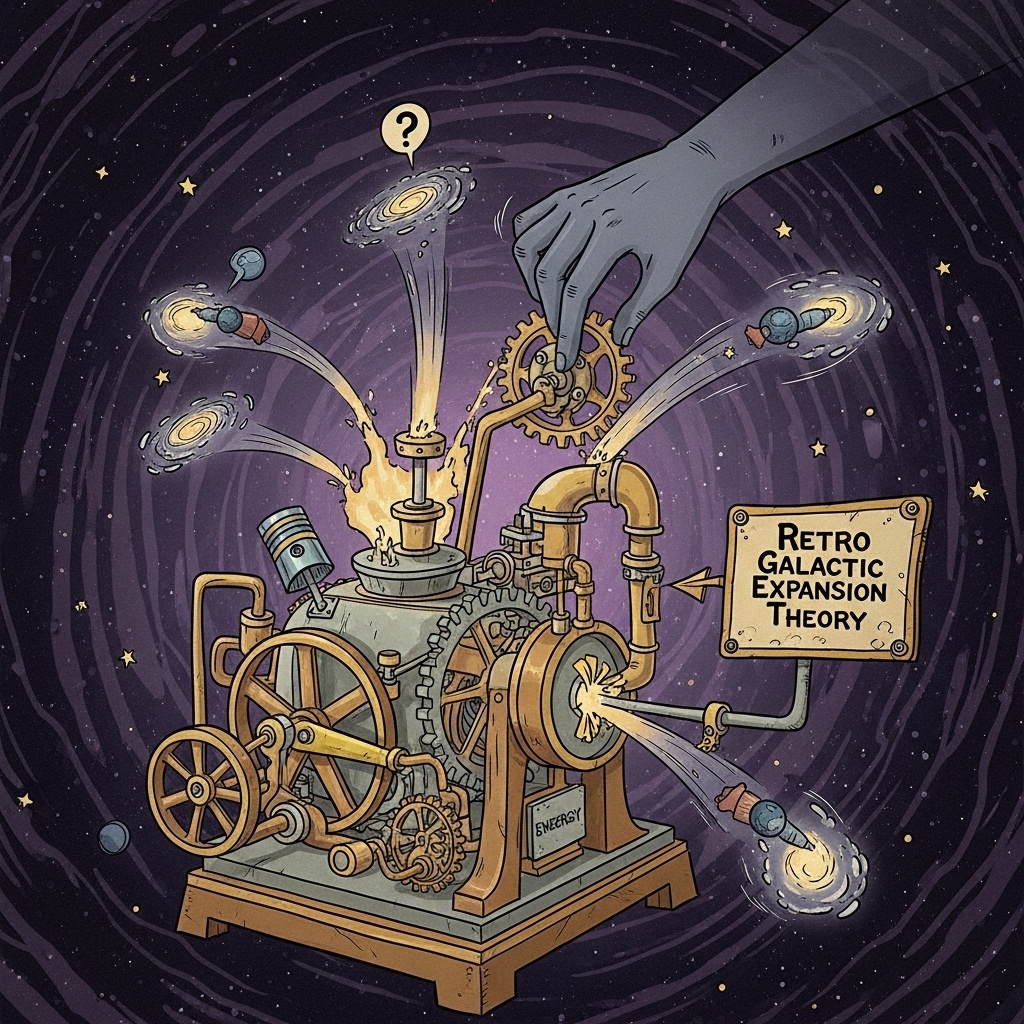
Introduction to Dark Energy and Retro Galactic Cosmic Expansion Theories
The discovery of dark energy has significantly impacted our understanding of the universe, particularly in the context of retro galactic cosmic expansion theories. Dark energy, a mysterious and invisible form of energy, is thought to be responsible for the accelerating expansion of the universe. This concept has challenged traditional views of cosmic expansion, which were previously believed to be slowing down due to gravity. In this article, we will delve into the implications of dark energy on retro galactic cosmic expansion theories, exploring the history, observations, and potential consequences of this phenomenon.
History of Cosmic Expansion Theories
The concept of cosmic expansion dates back to the 1920s, when Edwin Hubble observed that galaxies were moving away from each other. This led to the Big Bang theory, which suggests that the universe began as a single point and has been expanding ever since. Initially, it was believed that the expansion would slow down over time due to gravity. However, in the late 1990s, observations of distant supernovae revealed that the expansion was actually accelerating. This discovery led to the introduction of dark energy as a possible explanation for the observed acceleration.
Understanding Dark Energy
Dark energy is thought to make up approximately 68% of the universe's total energy density, while ordinary matter and dark matter account for around 5% and 27%, respectively. Despite its dominance, dark energy remains poorly understood, with its nature and properties still being researched. The most widely accepted theory is that dark energy is a property of space itself, spread evenly throughout the universe. This energy is thought to be responsible for the accelerating expansion, pushing matter apart and driving the universe's growth.
Implications of Dark Energy on Retro Galactic Cosmic Expansion Theories
The discovery of dark energy has significant implications for our understanding of the universe's evolution. In the context of retro galactic cosmic expansion theories, dark energy suggests that the universe's expansion was not always accelerating. Instead, it is believed that the expansion slowed down in the early universe, before dark energy became dominant and began to drive the acceleration. This challenges traditional views of cosmic expansion, which assumed a consistent deceleration over time. For example, the galaxy distribution and large-scale structure of the universe can be affected by dark energy, with simulations suggesting that the universe's web-like structure may be more complex than previously thought.
Observational Evidence for Dark Energy
Several lines of observational evidence support the existence of dark energy. These include the observation of distant supernovae, which appear fainter than expected due to the accelerating expansion. The cosmic microwave background radiation (CMB) also provides evidence for dark energy, with the CMB's temperature fluctuations consistent with a universe dominated by dark energy. Additionally, the large-scale structure of the universe, including the distribution of galaxies and galaxy clusters, can be used to constrain models of dark energy. For instance, the Sloan Digital Sky Survey (SDSS) has provided a vast amount of data on galaxy distributions, which can be used to test dark energy models.
Challenges and Future Directions
Despite the observational evidence, dark energy remains a topic of ongoing research and debate. One of the main challenges is understanding the nature of dark energy, with various theories attempting to explain its properties and behavior. Some theories, such as quintessence, propose that dark energy is a dynamic field that changes over time, while others, such as the cosmological constant, suggest that dark energy is a constant property of space. Future surveys, such as the Dark Energy Spectroscopic Instrument (DESI) and the Large Synoptic Survey Telescope (LSST), will provide further insights into dark energy, allowing us to better understand its role in the universe's evolution.
Conclusion
In conclusion, the implications of dark energy on retro galactic cosmic expansion theories are significant, challenging our understanding of the universe's evolution and expansion. While the discovery of dark energy has raised more questions than answers, ongoing research and observations are helping to shed light on this mysterious phenomenon. As our understanding of dark energy improves, we may uncover new insights into the universe's fundamental nature, ultimately refining our theories of cosmic expansion and the role of dark energy within it. The study of dark energy is an active area of research, with future surveys and observations poised to revolutionize our understanding of the universe and its mysterious dark energy component.