
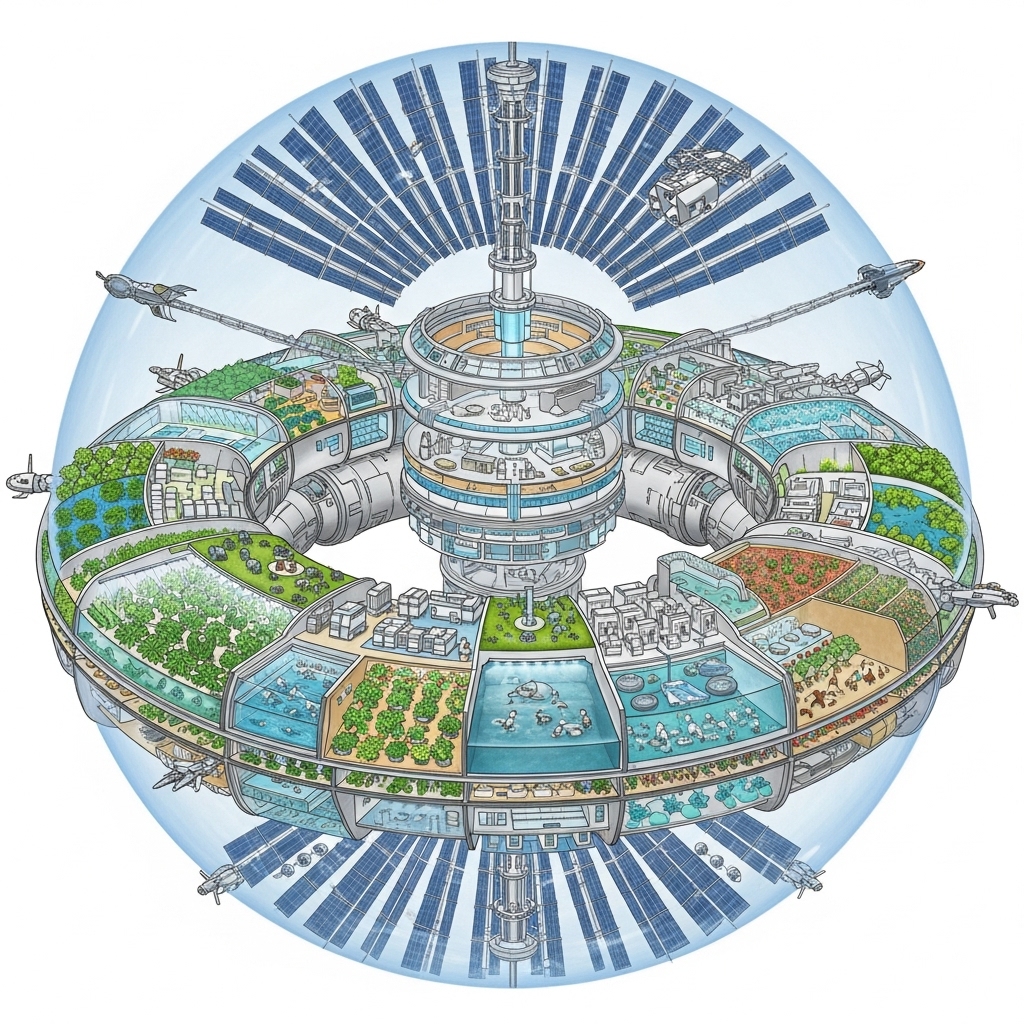
Introduction to Self-Sustaining Space Stations
A self-sustaining space station is a facility that can support human life for extended periods without the need for resupply from Earth. The concept of such a station has been a topic of interest for space agencies and private companies, as it could enable long-term space exploration and potentially even colonization. One of the critical aspects of designing a self-sustaining space station is its layout, which must balance various factors such as resource efficiency, radiation protection, and habitability. In this article, we will explore the ideal layout for a self-sustaining space station, considering the latest advancements in space habitat engineering.
Modular Design and Configuration
A modular design is essential for a self-sustaining space station, as it allows for flexibility, scalability, and easier maintenance. The station can be composed of multiple modules, each serving a specific purpose, such as living quarters, life support systems, power generation, and research facilities. For example, the International Space Station (ISS) is a modular space station, with modules added over time to expand its capabilities. A modular design also enables the station to be easily reconfigured or expanded as needed, reducing the risk of obsolescence and increasing its overall lifespan.
The configuration of the modules is also crucial, as it affects the overall efficiency and safety of the station. A cylindrical or spherical shape can provide the most efficient use of space, while also offering maximum protection from radiation and micrometeoroids. The modules can be connected using a central hub or a series of nodes, allowing for easy access and movement between modules.
Life Support Systems and Resource Management
A self-sustaining space station requires a reliable life support system, capable of recycling air, water, and waste, as well as producing food. The life support system should be designed to minimize waste and maximize resource efficiency, using technologies such as air and water recycling, hydroponics, and aeroponics. For instance, the European Space Agency's (ESA) MELISSA (Micro-Ecological Life Support System Alternative) project aims to develop a closed-loop life support system, where resources are continuously recycled and reused.
Resource management is also critical, as the station must be able to manage its resources effectively to ensure long-term sustainability. This includes managing energy generation, storage, and distribution, as well as waste management and recycling. The station can use renewable energy sources, such as solar panels or nuclear reactors, and implement energy-efficient systems to minimize energy consumption.
Radiation Protection and Shielding
Radiation protection is a significant concern for space stations, as prolonged exposure to cosmic radiation can be harmful to both humans and electronic equipment. The station's layout should be designed to provide maximum radiation shielding, using materials such as water, liquid hydrogen, or inflatable space habitats. For example, the Bigelow Aerospace's B330 space station uses inflatable modules, which provide excellent radiation shielding due to their thick, multi-layered structure.
The station can also use active radiation shielding, such as magnetic fields or electric fields, to deflect charged particles. Additionally, the station's orientation and trajectory can be optimized to minimize radiation exposure, by avoiding areas with high radiation levels, such as the South Atlantic Anomaly.
Artificial Gravity and Habitability
Artificial gravity is essential for long-term space missions, as prolonged exposure to microgravity can have adverse effects on the human body. The station's layout can incorporate rotating sections or centrifuges to create artificial gravity, which can help mitigate the effects of microgravity. For instance, the O'Neill cylinder, a conceptual space habitat design, uses a rotating cylinder to create artificial gravity through centrifugal force.
Habitability is also crucial, as the station must provide a comfortable and healthy environment for its occupants. The layout should include areas for recreation, exercise, and socialization, as well as private quarters and sanitary facilities. The station can also incorporate features such as virtual reality environments, hydroponic gardens, or aquariums to enhance the overall quality of life.
Robotics and Maintenance
Robotics and automation play a vital role in maintaining a self-sustaining space station, as they can perform tasks such as maintenance, repairs, and resource management. The station can be equipped with robotic arms, drones, or other autonomous systems to perform tasks that are difficult or impossible for humans to do. For example, the NASA's Robonaut 2, a humanoid robot, is designed to perform maintenance tasks on the ISS.
The station's layout should also be designed with maintenance in mind, with easy access to critical systems and components. The use of modular design and standardized components can simplify maintenance and reduce the risk of downtime. Additionally, the station can incorporate 3D printing and other manufacturing technologies to produce spare parts and tools on demand.
Conclusion and Future Directions
In conclusion, the ideal layout for a self-sustaining space station requires a careful balance of various factors, including resource efficiency, radiation protection, habitability, and maintenance. A modular design, life support systems, and resource management are critical components of a self-sustaining space station. The use of robotics, artificial gravity, and advanced materials can also enhance the station's overall performance and sustainability.
As space agencies and private companies continue to develop and deploy self-sustaining space stations, we can expect to see significant advancements in space habitat engineering. The development of lunar or Mars-based space stations, for example, will require innovative solutions to address the unique challenges of these environments. Ultimately, the creation of self-sustaining space stations will enable humanity to explore and settle the vastness of space, paving the way for a new era of space exploration and discovery.