
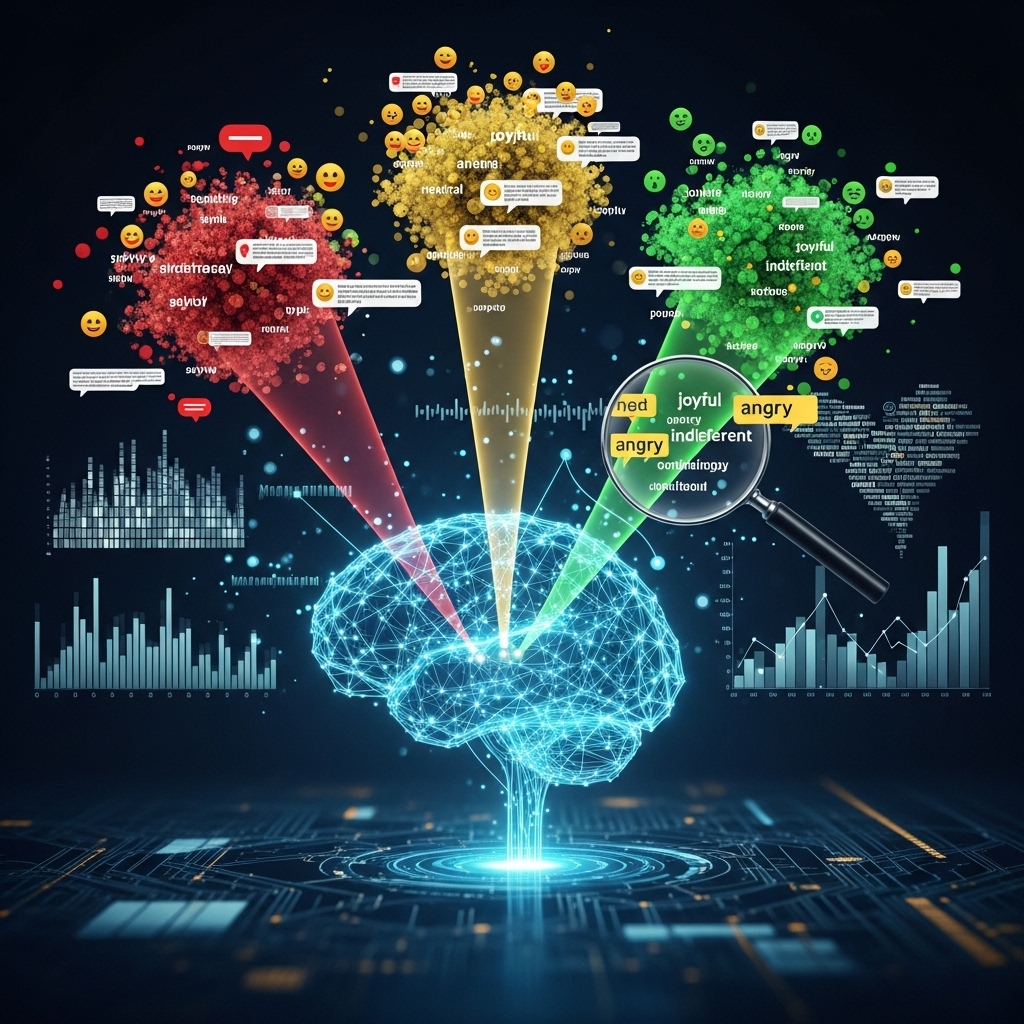
Introduction to Sentiment Analysis
Sentiment analysis, a subset of natural language processing (NLP), has emerged as a crucial tool in understanding the emotional nuances embedded within text data. With the proliferation of digital communication, the need to decipher the sentiment behind online reviews, social media posts, and customer feedback has become increasingly important for businesses, researchers, and individuals alike. This article delves into the mysteries of sentiment analysis, exploring its applications, challenges, and the role of AI in enhancing text exploration.
Understanding Sentiment Analysis
Sentiment analysis involves using algorithms to determine the emotional tone or attitude conveyed by a piece of text, which can range from positive, negative, to neutral. This process is complex due to the inherent ambiguity of human language, including sarcasm, irony, and figurative language, which can make it difficult for machines to accurately interpret sentiment. For instance, the sentence "What a beautiful day!" can be easily classified as positive, whereas "What a day, beautiful!" might require more context to determine its sentiment.
Applications of Sentiment Analysis
The applications of sentiment analysis are vast and varied, impacting numerous industries. In marketing, it helps companies gauge customer satisfaction and brand reputation by analyzing reviews and social media posts. For example, a hotel chain might use sentiment analysis to identify areas of improvement based on guest reviews, thereby enhancing customer experience and loyalty. In healthcare, sentiment analysis can be used to monitor patient outcomes and satisfaction with care, allowing for more personalized and effective treatment plans.
Challenges in Sentiment Analysis
Despite its potential, sentiment analysis faces several challenges. One of the primary hurdles is dealing with the subjectivity of language, where the same statement can elicit different emotions in different people. Additionally, the presence of slang, colloquialisms, and cultural references can complicate the analysis, especially when dealing with text from diverse geographical locations. The issue of context is also critical; a sentence might have a completely different meaning based on the preceding and following sentences.
Role of AI in Sentiment Analysis
Artificial Intelligence (AI) and machine learning (ML) have revolutionized the field of sentiment analysis by enabling more accurate and efficient analysis of text data. AI-driven models can learn from vast amounts of data, improving their ability to recognize patterns and nuances in language over time. Techniques such as deep learning, particularly recurrent neural networks (RNNs) and long short-term memory (LSTM) networks, have shown significant promise in capturing the complexities of human emotions expressed in text.
Techniques and Tools for Sentiment Analysis
Several techniques and tools are employed in sentiment analysis, including rule-based models, machine learning models, and hybrid models. Rule-based models rely on predefined rules to identify sentiment, whereas machine learning models are trained on datasets to learn patterns. Hybrid models combine these approaches, offering a more balanced and accurate analysis. Tools like NLTK, spaCy, and TextBlob are popular among developers and researchers for their ease of use and robust functionality in preprocessing text data and performing sentiment analysis.
Future of Sentiment Analysis
The future of sentiment analysis looks promising, with ongoing research aimed at improving its accuracy and applicability. The integration of multimodal sentiment analysis, which considers not just text but also images, videos, and audio, is expected to provide a more comprehensive understanding of human emotions. Furthermore, the application of sentiment analysis in real-time data streams, such as social media and live feedback systems, will enable instantaneous response and decision-making, revolutionizing fields like customer service and political analysis.
Conclusion
In conclusion, sentiment analysis is a powerful tool in the realm of NLP, offering insights into the emotional content of text data. While it faces challenges such as subjectivity and contextuality, the advancements in AI and ML are continually improving its accuracy and efficiency. As technology evolves, the applications of sentiment analysis are expected to expand, influencing various aspects of our digital and physical interactions. By unraveling the mysteries of sentiment analysis, we can harness its potential to create more empathetic machines and enhance human-machine interaction, paving the way for a future where technology not only understands but also resonates with human emotions.