
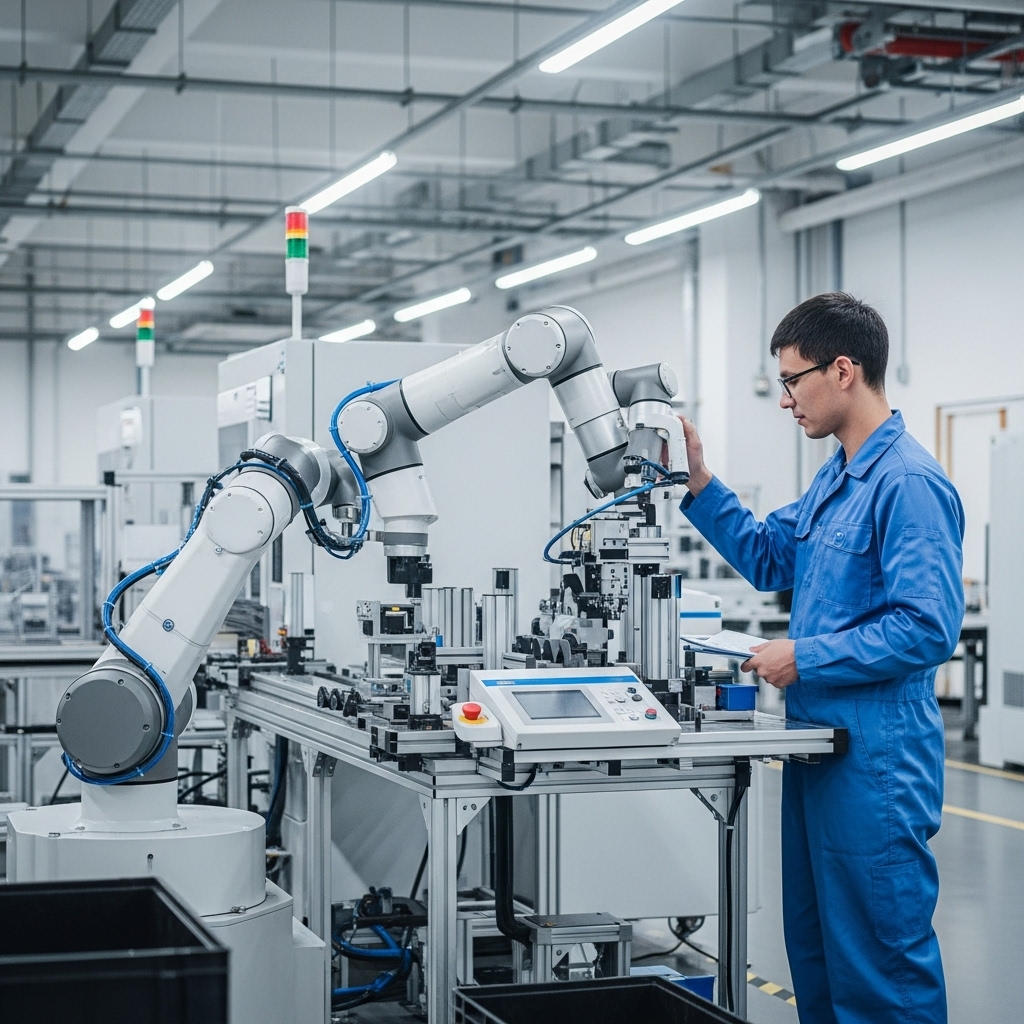
How Can Autonomous Industrial Cobots Enhance Factory Safety, Productivity, and Human–Robot Collaboration Through AI-Driven Vision and Adaptive Learning?
Introduction
Collaborative robots—commonly known as cobots—represent one of the most profound technological shifts in modern manufacturing. Unlike traditional industrial robots that operate within fenced areas and require strict isolation from human workers, cobots are engineered to function safely alongside humans. They are equipped with force sensors, vision systems, motion intent prediction models, and advanced AI safety layers that enable natural, intuitive collaboration. In the era of Industry 4.0 and intelligent automation, cobots serve as the bridge between full-scale industrial robotics and human-centric manufacturing environments.
This article begins a highly detailed, multi-part analysis of how AI-enhanced cobots reinforce operational safety, improve manufacturing throughput, adapt autonomously to dynamic tasks, and integrate into complex industrial ecosystems. It also examines the data pipelines, sensing architectures, simulation workflows, skill-learning algorithms, and regulatory frameworks that shape modern collaborative robotics. This is the first chunk of a comprehensive 10,000-word exploration.
1. Why Cobots Are Transforming Modern Manufacturing
Cobots offer several advantages over traditional robots:
- Safety by design: integrated torque limits, collision detection, force feedback, speed restrictions, and proximity monitoring.
- Rapid deployment: low setup time, minimal fencing, simplified programming interfaces.
- Flexible task allocation: pick-and-place, quality inspection, machine tending, screw driving, palletizing.
- Human augmentation: workers focus on complex decision-making while cobots handle repetitive or ergonomically taxing tasks.
- High ROI for SMEs: lower cost compared to industrial automation lines and suitable for small-batch production.
The rise of intelligent cobots is driven by AI, computer vision, and sensor fusion, enabling them to understand context, adapt to variability, and collaborate more naturally with humans.
2. Core Components of an AI-Driven Collaborative Robot System
A modern cobot integrates multiple subsystems working harmoniously:
- Actuation system: compliant joints, servo motors with force/torque sensing, low-inertia arms for safe impact mitigation.
- Perception system: RGB cameras, depth sensors, LiDAR, tactile arrays, proximity sensors, and sometimes radar for redundancy.
- AI decision layer: motion planning, human-intent prediction, quality inspection inference, and adaptive control loops.
- Safety layers: speed and separation monitoring (SSM), power and force limiting (PFL), workspace zoning, and emergency stop override.
- Human–machine interface: gesture controls, voice instructions, tablet UIs, AR overlays for task guidance.
This combination enables cobots to operate safely without reducing productivity.
3. Cobots and Human-Robot Collaboration (HRC)
Human–Robot Collaboration is at the center of cobot philosophy. HRC includes several modes:
- Coexistence: humans and robots work in shared areas with minimal interaction.
- Sequential collaboration: workers and cobots alternate tasks in shared workflows.
- Cooperation: humans and cobots work simultaneously on a shared object (e.g., assembly tasks).
- Responsive collaboration: cobot adapts real-time based on human cues such as gestures, motion, or tool usage.
AI-powered cobots enhance these modes by understanding human actions using vision models, pose estimation, trajectory prediction, and intent inference algorithms.
4. AI Computer Vision in Cobots
Computer vision is the backbone of autonomous cobot intelligence. Applications include:
- Object detection: parts, tools, pallets, bins, fixtures.
- Pose estimation: 6DoF orientation for precise picking or assembly.
- Hand tracking: ensuring safe separation when humans reach into shared areas.
- Quality inspection: identifying defects, missing screws, surface scratches, incorrect assembly.
- Task recognition: understanding worker actions to assist or anticipate next steps.
With multimodal vision-transformer-based models, cobots can generalize to new objects and tasks with minimal retraining.
5. Force Control and Safe Motion Adaptation
Safe physical interaction requires real-time force sensing and compliant motion control. Cobots monitor joint torques and surface pressure to detect unintended contact. When force exceeds a threshold, the cobot may slow, retract, or stop entirely. Advanced techniques such as impedance control, admittance control, and hybrid force/position control enable precise manipulation while maintaining safety.
Examples:
- Machine tending: cobot applies controlled force to operate levers or insert parts without damaging equipment.
- Assembly tasks: cobot adjusts motion based on tactile cues when fitting parts together.
Cobots can also learn optimal force patterns via demonstration-learning systems.
6. Adaptive Learning and Task Generalization
Learning-based cobots use algorithms to generalize tasks beyond their programming. Common strategies include:
- Learning from Demonstration (LfD): human demonstrations recorded via kinesthetic teaching or teleoperation.
- Reinforcement learning: optimizing trajectories, grip strength, or inspection routes via reward functions.
- Few-shot learning: using minimal examples to learn new object categories.
- Multimodal embeddings: combining vision, force signals, speech commands, and textual instruction prompts.
This enables cobots to self-adjust to new parts, environmental changes, and production variations.
7. Digital Twins for Collaborative Robots
Digital twins enhance cobot performance through:
- Offline simulation: test new workflows without disrupting production.
- Collision prediction: evaluate human–robot movement interactions.
- Task optimization: generate efficient trajectories and reduce idle time.
- Sensitivity analysis: predict risk zones when human operators move unpredictably.
Simulation engines model both human behavior and robot motion, allowing safer deployment.
8. Workplace Safety and Regulatory Frameworks
Cobots must follow ISO/TS 15066 guidelines addressing:
- Force thresholds
- Speed limits
- Separation distances
- Sensor redundancy
- Impact pressure limits
AI systems must include explainable safety logic and fallback behaviors to maintain compliance.