
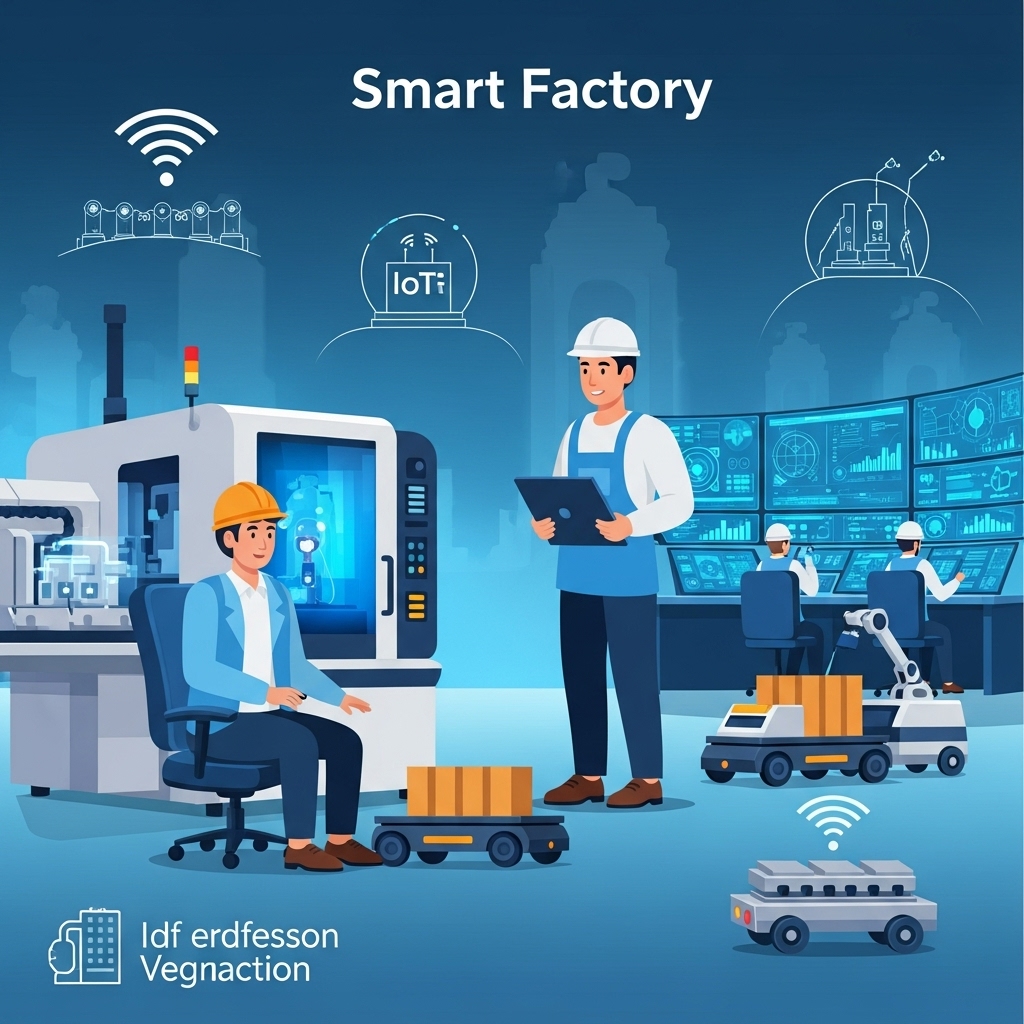
How Can Digital Twin Robotics Revolutionize Industrial Automation and Enable Hyper-Resilient Smart Factories?
Introduction
Digital Twin Robotics represents a next-generation manufacturing paradigm built upon Industry 4.0 fundamentals, cyber-physical integration, simulation intelligence, and autonomous operational feedback loops. At its core, a digital twin is a dynamic, high-fidelity virtual representation of a physical robotics system—mirroring its structure, behavior, states, performance, constraints, and real-time operational data. In modern industrial environments, where downtime costs millions and operational complexity exponentially increases with automation density, digital twins serve as predictive, preventive, and optimization-driven control centers.
The transformative potential of Digital Twin Robotics extends far beyond simulation. These systems create a continuously synchronized relationship between the physical factory floor and its digital counterpart, enabling real-time diagnostics, predictive maintenance, autonomous workflow optimization, adaptive routing, robotic path reconfiguration, virtual commissioning, and scenario forecasting without interrupting ongoing production. This capability fundamentally redefines how factories design, deploy, manage, and scale robotic automation.
This article explores the technical foundations, layered architectures, data infrastructure, simulation models, AI algorithms, edge computing integrations, SCADA interoperability, predictive analytics pipelines, and operational governance frameworks required to unlock hyper-resilient, self-optimizing smart manufacturing ecosystems. This is the beginning of a deeply detailed, multi-chunk 10,000-word analysis.
1. Understanding the Core Concept of Digital Twin Robotics
A robotic digital twin is more than a 3D model. It encapsulates multi-layered constructs:
- Geometric twin: CAD-derived 3D geometry, kinematic chains, joint constraints, collision bodies, environment obstacles.
- Behavioral twin: Control logic, PLC programs, motion trajectories, PLC ladder logic, robot controller parameters.
- Operational twin: State variables such as speeds, torques, temperatures, cycle times, throughput metrics, and tool conditions.
- Data twin: Real-time telemetry from sensors (vibration, force, encoders, load cells) synchronized with the digital model.
- AI-enhanced twin: Predictive models, reinforcement-learning agents, optimization algorithms, simulation intelligence.
The power of Digital Twin Robotics arises when all these layers interoperate continuously and bi-directionally—forming a unified intelligence system capable of monitoring, predicting, planning, and adapting physical robotic processes with unprecedented accuracy.
2. Why Digital Twins Are Becoming Essential in Modern Manufacturing
Manufacturing systems today face extreme complexity. Robots operate alongside conveyors, CNC machines, AGVs, AMRs, PLC networks, and human workers. Introducing even minor workflow changes often demands expensive downtime, safety re-certification, and manual recalibration.
Digital twin robotics eliminates these bottlenecks by allowing manufacturers to test, validate, and optimize changes virtually. The benefits include:
- Zero-risk experimentation: Line reconfiguration, new tools, updated trajectories, or cycle-time changes can be validated offline.
- Reduced commissioning time: Virtual commissioning accelerates deployment from weeks to days.
- Predictive maintenance: Failure-prone components can be forecasted before downtime occurs.
- Increased throughput: AI-enhanced optimization improves motion paths, energy efficiency, takt time, and sequencing.
- Higher quality output: Twins detect micro-anomalies invisible to human operators.
- Lower operational cost: Reduced unplanned stoppages, material waste, and energy consumption.
As supply chains globalize and product lifecycles shorten, factories require unprecedented agility. Digital Twin Robotics is the most advanced, future-proof method to achieve operational agility while preserving safety, accuracy, and reliability.
3. Architecture of a Digital Twin Robotics Ecosystem
A comprehensive ecosystem comprises layered components:
3.1 Physical Layer
Includes industrial robots, actuators, servo drives, end-effectors, conveyors, vision systems, LiDAR scanners, force sensors, AGVs, AMRs, and safety PLCs. This is the source of ground truth for the twin.
3.2 Edge Layer
The edge computing layer acts as a gateway between physical and digital systems. Functions include:
- Real-time data ingestion
- Signal preprocessing
- Protocol translation (Modbus, PROFINET, OPC-UA, EtherCAT)
- Local anomaly detection
- Deterministic buffering for high-frequency telemetry
3.3 Cloud / Data Infrastructure Layer
This layer stores and processes large-scale telemetry, twin models, historical logs, simulation results, and optimization datasets. It may use:
- Data lakes for structured & unstructured data
- Event-driven architectures (Kafka, MQTT streams)
- Time-series databases for telemetry
- Model repositories for simulation & ML assets
3.4 Simulation Engine
This engine mirrors physical behavior using:
- Physics-based simulation (rigid-body, kinematics, fluid, thermal)
- Behavior modeling (PLC, HIL, SIL)
- Sensor simulation (camera, LiDAR, force, torque, IMU)
- Collision detection & environment modeling
3.5 AI & Optimization Layer
This intelligence layer enhances decision-making:
- Predictive maintenance models
- Cycle-time optimization algorithms
- Reinforcement learning for path optimization
- Generative simulation AI for scenario exploration
- Anomaly detection models for quality control
3.6 Visualization & Control Layer
Operators interface with:
- 3D dashboards
- Augmented reality maintenance overlays
- SCADA dashboards
- MES (Manufacturing Execution System) tools
- Robotic programming editors
4. Data Pipelines and Telemetry Synchronization
Digital twins rely on continuous data synchronization. This requires:
- High-frequency telemetry capture: encoder positions, forces, torques, speeds.
- Low-latency streaming: near real-time MQTT or WebSocket streams.
- Time-aligned sensor fusion: video, LiDAR, force sensors, and PLC cycles aligned through timestamps.
- Feedback loops: Predictions from the twin sent back to edge controllers for adaptive corrections.
Data integrity is paramount. Implement redundancy, CRC error checking, timestamp correction algorithms, and failover routing to ensure the twin accurately mirrors the real robotic system.
5. Virtual Commissioning and Offline Testing
One of the most impactful use cases of digital twin robotics is virtual commissioning—testing an entire robotic cell before deployment. This reduces risk and accelerates deployment timelines.
Capabilities include:
- Offline programming (OLP)
- Collision detection validation
- End-effector reachability tests
- PLC logic emulation
- Motion planning verification
- Safety zone validation
Engineers can detect issues such as singularities, unreachable poses, excessive joint torque, or timing mismatches long before equipment reaches the production floor.
6. Role of SCADA and PLC Integration
SCADA systems serve as the supervisory control layer, while PLCs handle real-time actuation. Digital Twin Robotics integrates deeply with both:
- SCADA → twin: telemetry, alarms, energy usage, cycle times.
- Twin → SCADA: optimized setpoints, predictive warnings, task recommendations.
- PLC → twin: real-time states, I/O status, motor conditions.
- Twin → PLC: validated new motion sequences or updated logic.
This bi-directional loop enables factories to transition toward semi-autonomous and eventually fully autonomous robotic operations.