
Introduction to Aptitude and Intelligence Quotient
Aptitude and Intelligence Quotient (IQ) are two terms that are often used interchangeably, but they have distinct meanings. While both terms refer to a person's cognitive abilities, they measure different aspects of human intelligence. In this article, we will delve into the differences between aptitude and IQ, exploring what each term means, how they are measured, and what they signify. By understanding the distinction between these two concepts, we can better appreciate the complexities of human cognition and how they impact our daily lives.
Defining Aptitude
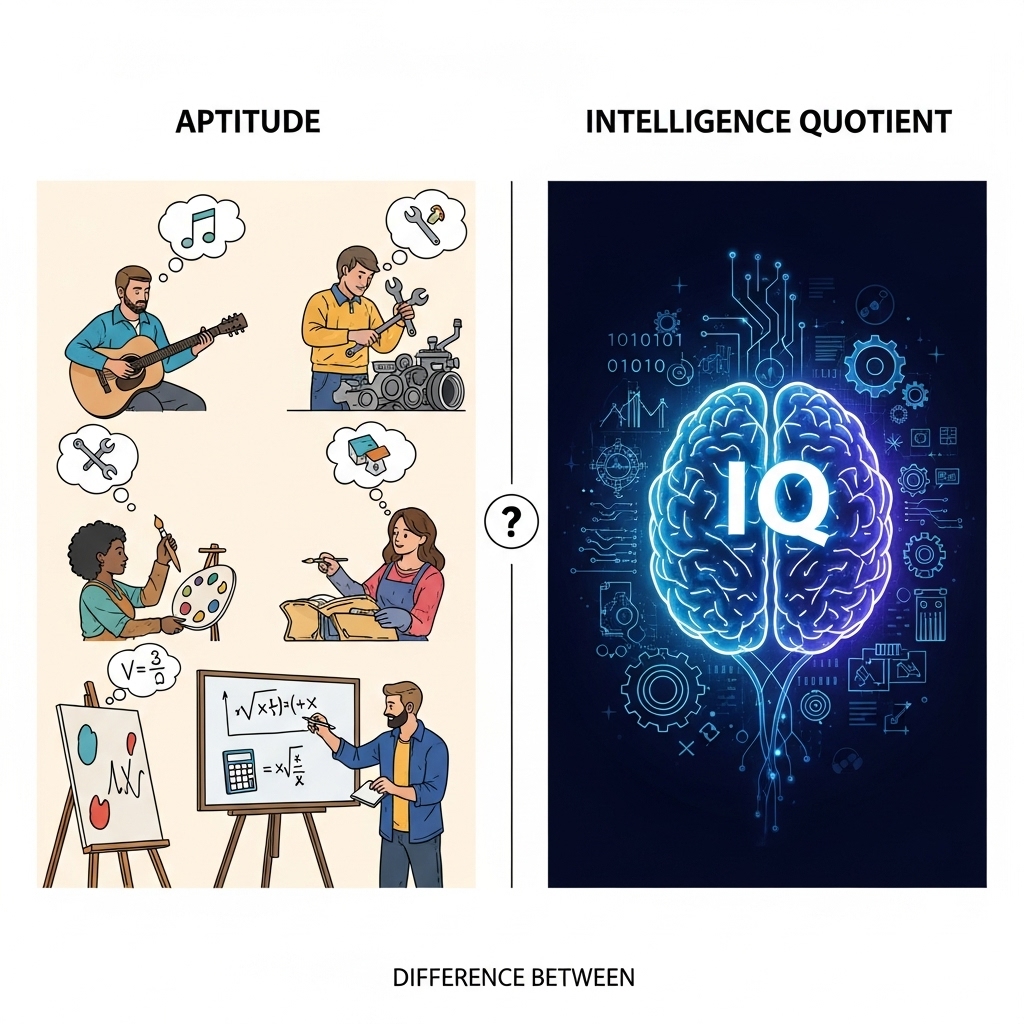
Aptitude refers to a person's natural ability or talent for a specific task or activity. It is the potential to learn or perform a particular skill, and it is often used to predict future success in a given area. Aptitude is not solely determined by intelligence, but rather by a combination of factors, including innate ability, education, and experience. For example, a person may have a high aptitude for music, but struggle with mathematics. Aptitude tests are designed to measure a person's potential for success in a specific field or profession, such as law, medicine, or engineering.
Defining Intelligence Quotient (IQ)
Intelligence Quotient (IQ) is a score derived from a standardized test designed to measure human intelligence. IQ tests are intended to assess a person's cognitive abilities, including reasoning, problem-solving, and thinking. The average IQ score is set at 100, with most people scoring between 85 and 115. IQ scores are often used to predict academic and professional success, as well as to identify individuals with exceptional cognitive abilities. However, IQ scores have been criticized for their limitations, as they do not account for important aspects of human intelligence, such as creativity, emotional intelligence, and practical problem-solving skills.
Key Differences Between Aptitude and IQ
The main difference between aptitude and IQ is that aptitude refers to a person's potential for success in a specific area, while IQ is a broader measure of cognitive abilities. Aptitude tests are designed to predict future performance in a particular field, whereas IQ tests aim to assess general intelligence. Another key difference is that aptitude is not solely determined by intelligence, whereas IQ is often seen as a measure of innate cognitive ability. For instance, a person may have a high IQ but struggle with practical tasks, such as time management or communication, which are essential for success in many professions.
Measuring Aptitude and IQ
Aptitude and IQ are measured using different types of tests. Aptitude tests are typically designed to assess a person's potential for success in a specific area, such as the SAT for college admissions or the LSAT for law school. These tests often include questions that are relevant to the field or profession, as well as assessments of critical thinking and problem-solving skills. IQ tests, on the other hand, are designed to measure general cognitive abilities, such as reasoning, memory, and spatial reasoning. Examples of IQ tests include the Stanford-Binet Intelligence Scale and the Wechsler Adult Intelligence Scale (WAIS).
Implications of Aptitude and IQ
Understanding the difference between aptitude and IQ has significant implications for education, career development, and personal growth. By recognizing a person's aptitude for a particular field or profession, educators and employers can provide targeted support and training to help them succeed. IQ scores, on the other hand, can be used to identify individuals with exceptional cognitive abilities, who may benefit from specialized programs or resources. Additionally, recognizing the limitations of IQ scores can help to promote a more nuanced understanding of human intelligence, one that values diverse cognitive abilities and strengths.
Conclusion
In conclusion, aptitude and Intelligence Quotient (IQ) are two distinct concepts that measure different aspects of human cognition. While aptitude refers to a person's natural ability or talent for a specific task or activity, IQ is a broader measure of cognitive abilities. By understanding the differences between these two concepts, we can better appreciate the complexities of human intelligence and provide more effective support and resources for individuals to succeed in their chosen fields. Ultimately, recognizing the importance of both aptitude and IQ can help to promote a more inclusive and nuanced understanding of human potential, one that values diverse cognitive abilities and strengths.