
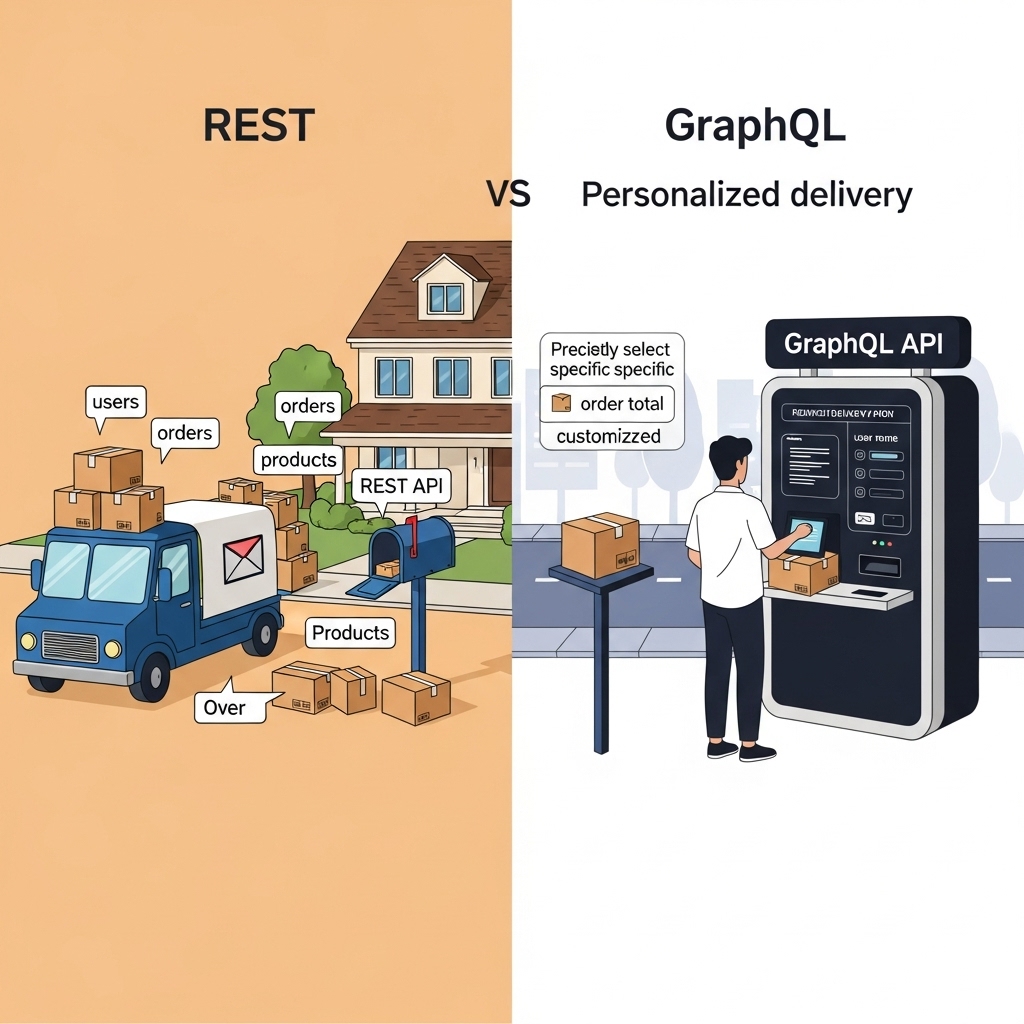
Introduction to REST and GraphQL APIs
When it comes to building web applications, APIs (Application Programming Interfaces) play a crucial role in enabling communication between different systems and services. Two popular API architectures are REST (Representational State of Resource) and GraphQL. While both enable data exchange, they differ significantly in their approach, advantages, and use cases. In this article, we will delve into the differences between REST and GraphQL APIs, exploring their strengths, weaknesses, and scenarios where one might be more suitable than the other.
Understanding REST APIs
REST APIs, also known as RESTful APIs, are an architectural style for designing networked applications. They rely on a stateless, client-server, cacheable, and uniform interface. Resources are identified by URIs, and each resource can be manipulated using a fixed set of operations. The most common HTTP methods used in REST APIs are GET, POST, PUT, and DELETE, which correspond to read, create, update, and delete operations, respectively. REST APIs typically return data in JSON or XML format. One of the key advantages of REST APIs is their simplicity and the fact that they are widely adopted and understood, making it easier for developers to learn and use them.
For example, a simple REST API for managing books might have endpoints like GET /books to retrieve a list of all books, POST /books to create a new book, GET /books/{id} to get a specific book by ID, PUT /books/{id} to update a book, and DELETE /books/{id} to delete a book. This approach is straightforward and easy to implement but can lead to over-fetching or under-fetching of data, as the client must request entire resources even if it only needs a subset of the data.
Understanding GraphQL APIs
GraphQL is a query language for APIs and a runtime for fulfilling those queries with your existing data. It was developed by Facebook to cope with the limitations of REST APIs, particularly in mobile applications where data transfer needs to be efficient. Unlike REST, GraphQL allows clients to specify exactly what data they need, and the server returns only that data, reducing the amount of data transferred. GraphQL APIs typically have a single endpoint, and clients can query the data using a query language. This approach provides more flexibility and can reduce the number of requests needed to fetch related data.
A GraphQL schema defines the types of data available and the relationships between them. For instance, in a GraphQL API for managing books, a query might look like query { books { id title author } } to fetch the IDs, titles, and authors of all books. GraphQL also supports more complex queries, such as fetching related objects in a single request, which can significantly reduce the number of requests needed compared to REST.
Comparison of REST and GraphQL
The choice between REST and GraphQL depends on several factors, including the complexity of the data, the needs of the client applications, and the development team's experience. REST is generally simpler to implement and understand, especially for simple, CRUD (Create, Read, Update, Delete) operations. However, as the complexity of the data model increases, or when dealing with mobile applications where bandwidth is a concern, GraphQL's ability to fetch specific data can be more efficient. GraphQL also provides better support for real-time updates and subscriptions, making it suitable for applications that require live data updates.
Another significant difference is how errors are handled. REST APIs typically return error codes and messages in a standardized way, whereas GraphQL returns errors alongside successful data in the same response, allowing for more granular error handling. This can be both an advantage and a disadvantage, depending on how the client application is designed to handle errors.
Security Considerations
Both REST and GraphQL APIs need to be secured properly to prevent unauthorized access and data breaches. Common security practices include authentication (to verify the identity of users) and authorization (to control what actions users can perform). REST APIs often use token-based authentication, where a token is passed in the header of each request. GraphQL APIs can use similar authentication methods but may also leverage GraphQL-specific directives for authentication and authorization.
GraphQL's flexibility can also introduce security risks if not properly validated. For example, a malicious query could request a large amount of data or recursively fetch data in a way that could lead to a denial-of-service (DoS) attack. Therefore, it's crucial to implement proper query validation, rate limiting, and monitoring in GraphQL APIs.
Conclusion
In conclusion, the choice between REST and GraphQL APIs should be based on the specific requirements of your application and the trade-offs you are willing to make. REST APIs are well-suited for simple, resource-based applications with straightforward data models, while GraphQL is more appropriate for complex, data-driven applications that require flexible and efficient data fetching. Understanding the strengths and weaknesses of each approach will help you design more effective and scalable APIs. As the landscape of web development continues to evolve, mastering both REST and GraphQL will become increasingly valuable for developers aiming to build robust, data-driven applications.