
Introduction to Dental Fillings
Dental fillings are a common procedure in operative dentistry, used to restore teeth that have been damaged by decay or trauma. The primary goal of a dental filling is to remove the decayed portion of the tooth and fill the resulting cavity with a material that will prevent further decay and restore the tooth's function and appearance. There are several types of dental fillings available, but two of the most common are composite and amalgam fillings. In this article, we will explore the differences between these two types of fillings, including their composition, advantages, and disadvantages.
Composition of Composite and Amalgam Fillings
Composite fillings are made from a mixture of resin and filler particles, such as glass or ceramic. The resin is a type of plastic that is bonded to the tooth using a special light, while the filler particles provide strength and durability to the filling. Amalgam fillings, on the other hand, are made from a mixture of mercury, silver, tin, and copper. The mercury is used to bind the other metals together, creating a strong and durable filling. However, the use of mercury in amalgam fillings has raised concerns about their safety and potential health risks.
Advantages of Composite Fillings
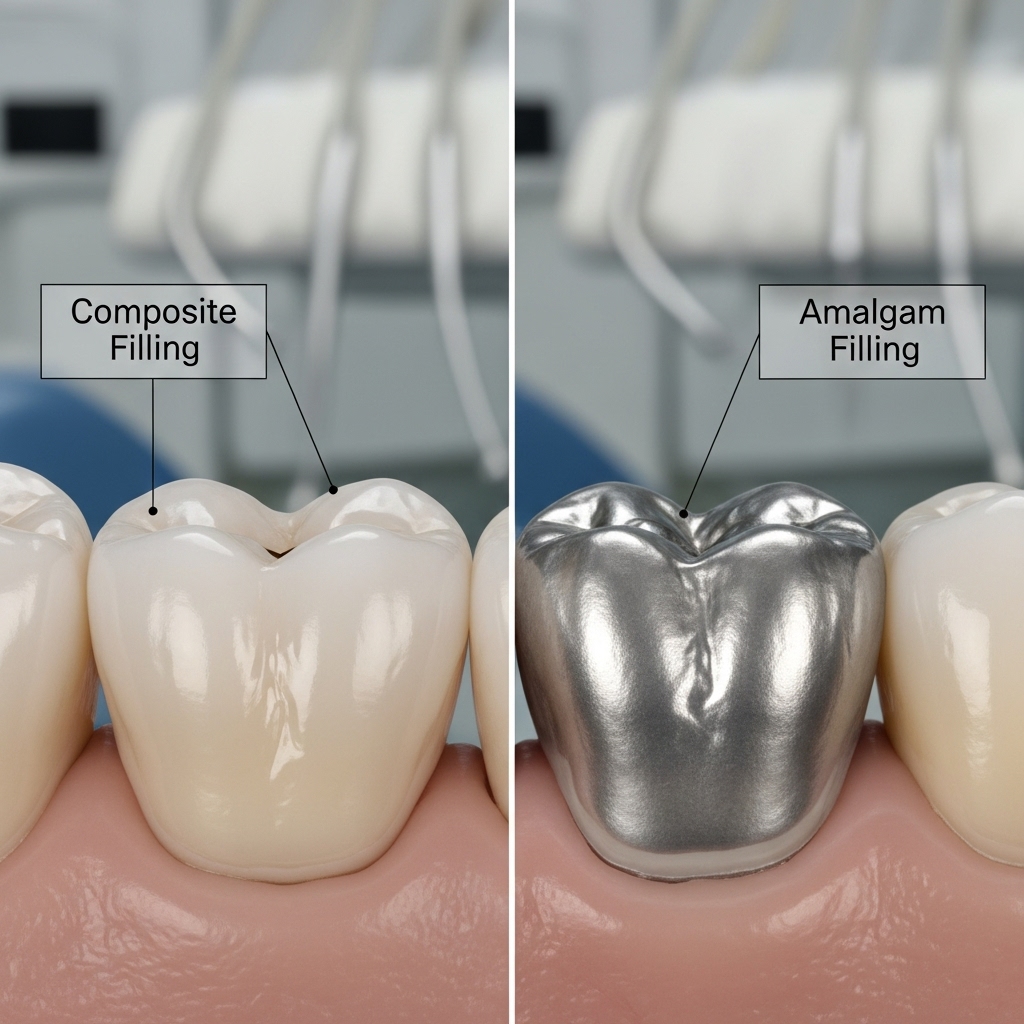
Composite fillings have several advantages over amalgam fillings. One of the main advantages is their aesthetic appeal. Composite fillings can be matched to the color of the surrounding tooth, making them virtually invisible. They are also more versatile than amalgam fillings, and can be used to repair teeth that are cracked or chipped, as well as those that have decay. Additionally, composite fillings are less likely to cause sensitivity or discomfort, as they do not conduct heat or cold in the same way that amalgam fillings do. For example, a patient who has a composite filling in a tooth that is sensitive to temperature changes may find that the sensitivity is reduced or eliminated after the filling is placed.
Disadvantages of Composite Fillings
Despite their advantages, composite fillings also have some disadvantages. One of the main disadvantages is their cost. Composite fillings are generally more expensive than amalgam fillings, although the cost difference is decreasing as the technology improves. Another disadvantage is the time and skill required to place a composite filling. The process of placing a composite filling is more complex and time-consuming than placing an amalgam filling, and requires a high level of skill and training. For example, the dentist must carefully prepare the tooth, apply the resin and filler particles, and shape and polish the filling to create a natural-looking result.
Advantages of Amalgam Fillings
Amalgam fillings have several advantages, despite the concerns about their safety. One of the main advantages is their durability. Amalgam fillings are extremely hard and can withstand the forces of chewing and biting for many years. They are also relatively inexpensive, making them a cost-effective option for patients who need a filling. Additionally, amalgam fillings are easy to place, and the process is relatively quick and straightforward. For example, a dentist can place an amalgam filling in a matter of minutes, whereas a composite filling may take 30 minutes or more to place.
Disadvantages of Amalgam Fillings
Despite their advantages, amalgam fillings also have some significant disadvantages. One of the main disadvantages is their appearance. Amalgam fillings are silver in color, which can be noticeable, especially in visible teeth. They can also cause discoloration of the surrounding tooth, making it appear gray or black. Additionally, amalgam fillings contain mercury, which has raised concerns about their safety and potential health risks. For example, some patients may be concerned about the potential for mercury to leach out of the filling and into the body, although the evidence suggests that this is unlikely.
Conclusion
In conclusion, the choice between composite and amalgam fillings depends on a variety of factors, including the patient's needs and preferences, the location and extent of the decay, and the dentist's professional judgment. While composite fillings offer several advantages, including their aesthetic appeal and versatility, they are generally more expensive and require more time and skill to place. Amalgam fillings, on the other hand, are durable and cost-effective, but may be less desirable due to their appearance and potential health risks. Ultimately, the best type of filling for a patient will depend on their individual needs and circumstances, and should be determined in consultation with a qualified dentist.