
Introduction to Taxonomy Management
Taxonomy management refers to the process of creating, maintaining, and managing a taxonomy, which is a hierarchical system used to classify and organize data, objects, or concepts into categories and subcategories. Effective taxonomy management is crucial in today's digital age, where vast amounts of data are generated and need to be organized, searched, and retrieved efficiently. In this article, we will delve into the world of taxonomy management, exploring its importance, benefits, and best practices, as well as its impact on data organization.
What is a Taxonomy?
A taxonomy is a system of classification that uses a hierarchical structure to organize and categorize data, objects, or concepts. It consists of a set of terms, known as taxonomic terms or concepts, which are arranged in a specific order to create a tree-like structure. Each term in the taxonomy has a specific meaning and is related to other terms through a set of relationships, such as "is-a" or "part-of". Taxonomies can be simple or complex, depending on the scope and depth of the classification system. For example, a simple taxonomy might categorize animals into mammals, birds, and reptiles, while a more complex taxonomy might include subcategories such as species, genus, and family.
Benefits of Taxonomy Management
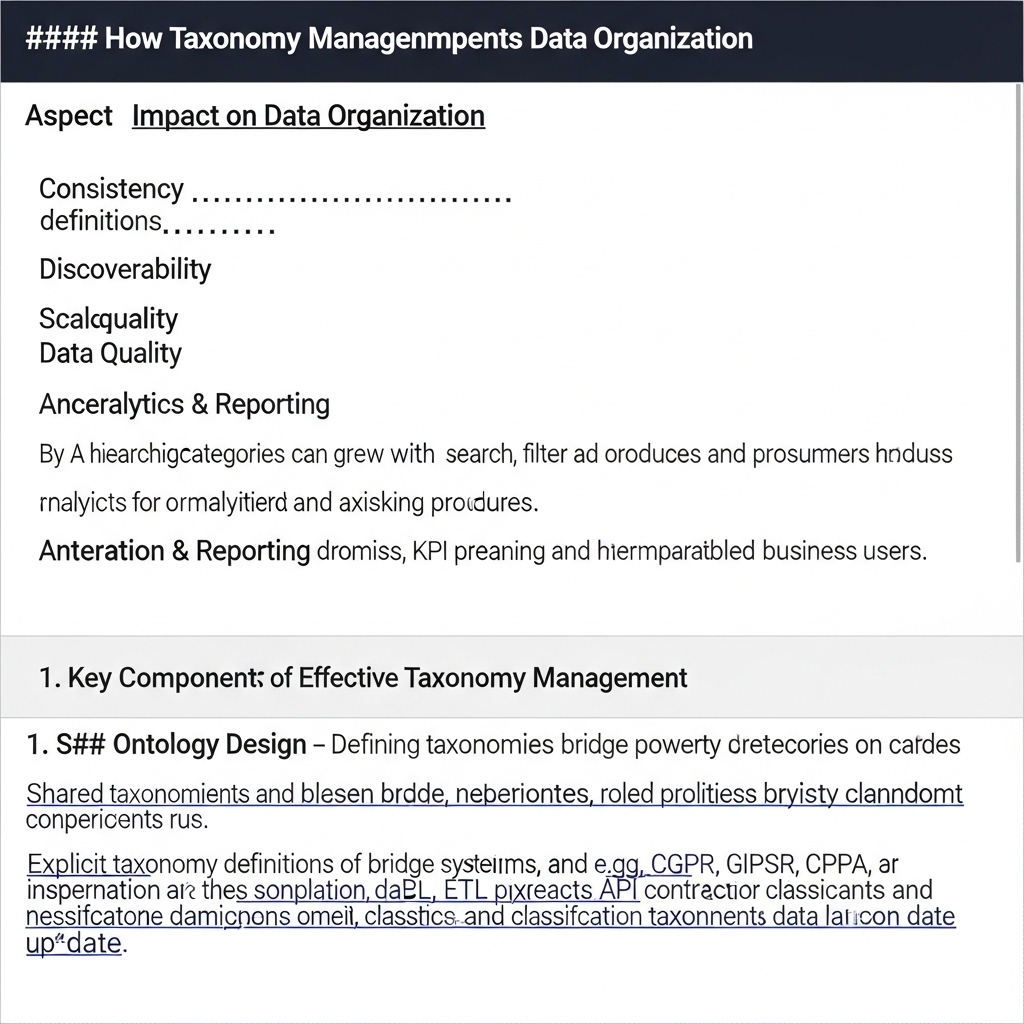
Effective taxonomy management offers numerous benefits, including improved data organization, enhanced search and retrieval, and increased efficiency. By creating a well-structured taxonomy, organizations can ensure that their data is consistently classified and categorized, making it easier to locate and access. This, in turn, can lead to improved decision-making, as users can quickly and easily find the information they need. Additionally, a well-managed taxonomy can help to reduce errors and inconsistencies, as data is classified and categorized in a standardized way. For instance, a company like Amazon uses a taxonomy to categorize its products, making it easy for customers to find what they are looking for.
Types of Taxonomies
There are several types of taxonomies, each with its own strengths and weaknesses. Some common types of taxonomies include hierarchical taxonomies, faceted taxonomies, and network taxonomies. Hierarchical taxonomies are the most common type, where terms are arranged in a tree-like structure, with each term having a single parent and multiple children. Faceted taxonomies, on the other hand, use multiple dimensions or facets to classify data, allowing for more flexibility and nuance. Network taxonomies, also known as ontologies, use a web-like structure to represent complex relationships between terms. For example, a hierarchical taxonomy might categorize vehicles into cars, trucks, and motorcycles, while a faceted taxonomy might use dimensions such as color, size, and fuel type to classify vehicles.
Best Practices for Taxonomy Management
Effective taxonomy management requires careful planning, maintenance, and governance. Some best practices for taxonomy management include establishing clear goals and objectives, involving stakeholders in the taxonomy development process, and using standardized terminology and classification systems. It is also important to regularly review and update the taxonomy to ensure it remains relevant and effective. Additionally, taxonomies should be designed to be flexible and adaptable, allowing for changes and updates over time. For instance, a company like Google uses a taxonomy to categorize its search results, and regularly updates its taxonomy to reflect changes in user behavior and search trends.
Challenges and Limitations of Taxonomy Management
While taxonomy management offers many benefits, it also presents several challenges and limitations. One of the main challenges is ensuring that the taxonomy is comprehensive and accurate, covering all relevant terms and concepts. Another challenge is maintaining the taxonomy over time, as new terms and concepts emerge, and old ones become obsolete. Additionally, taxonomies can be culturally and linguistically sensitive, requiring careful consideration of different perspectives and contexts. For example, a taxonomy developed in one culture or language may not be applicable in another, highlighting the need for cultural and linguistic sensitivity in taxonomy development.
Conclusion
In conclusion, taxonomy management is a critical aspect of data organization, enabling organizations to create, maintain, and manage hierarchical systems for classifying and categorizing data, objects, or concepts. By understanding the importance of taxonomy management, and implementing best practices, organizations can improve data organization, enhance search and retrieval, and increase efficiency. While taxonomy management presents several challenges and limitations, the benefits of effective taxonomy management far outweigh the costs, making it an essential component of any data management strategy. As data continues to grow and evolve, the need for effective taxonomy management will only continue to increase, highlighting the importance of investing in taxonomy management today.