
Introduction to Digital Twin Validation
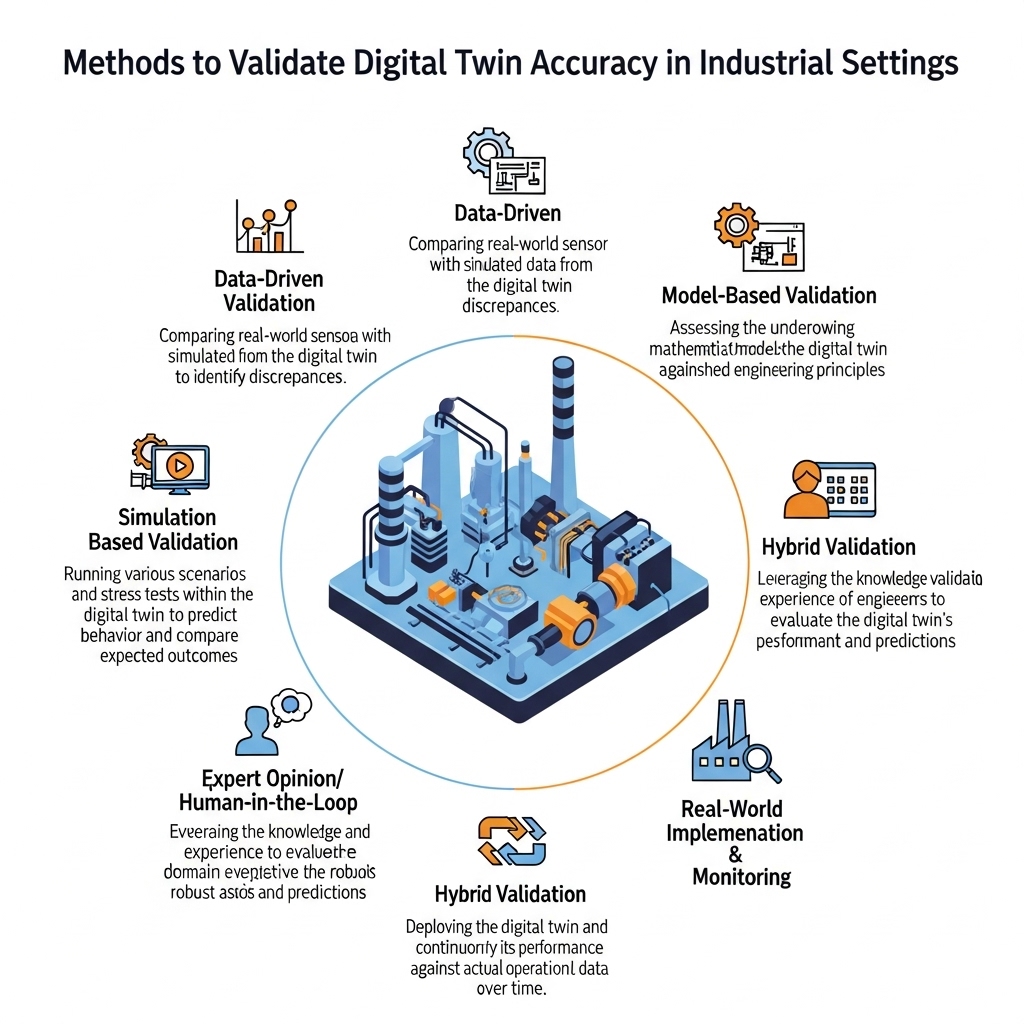
Digital twins are virtual replicas of physical assets, systems, or processes, and they have been increasingly adopted in various industrial settings to improve efficiency, reduce costs, and enhance decision-making. However, the accuracy of digital twins is crucial to their effectiveness, and validating their accuracy is essential to ensure that they provide reliable and trustworthy insights. In this article, we will explore the methods used to validate digital twin accuracy in industrial settings.
Physical Validation Methods
Physical validation methods involve comparing the digital twin's predictions or simulations with real-world data collected from sensors, experiments, or other physical measurements. This approach helps to ensure that the digital twin accurately represents the physical system's behavior and performance. For example, in the aerospace industry, physical validation methods are used to validate the accuracy of digital twins of aircraft engines, where sensors and testing equipment are used to collect data on engine performance, which is then compared to the digital twin's simulations.
Another example is in the manufacturing industry, where physical validation methods are used to validate the accuracy of digital twins of production lines. Sensors and cameras are used to collect data on production processes, which is then compared to the digital twin's simulations to ensure that the digital twin accurately represents the production line's behavior and performance.
Data-Driven Validation Methods
Data-driven validation methods involve using data analytics and machine learning algorithms to validate the accuracy of digital twins. This approach involves analyzing large datasets collected from various sources, such as sensors, logs, and other data sources, to identify patterns and trends that can be used to validate the digital twin's accuracy. For example, in the energy industry, data-driven validation methods are used to validate the accuracy of digital twins of power grids, where data analytics and machine learning algorithms are used to analyze data on energy consumption, generation, and transmission to ensure that the digital twin accurately represents the power grid's behavior and performance.
Another example is in the healthcare industry, where data-driven validation methods are used to validate the accuracy of digital twins of patient care pathways. Electronic health records and other data sources are used to collect data on patient outcomes, which is then analyzed using data analytics and machine learning algorithms to validate the digital twin's accuracy and identify areas for improvement.
Hybrid Validation Methods
Hybrid validation methods involve combining physical and data-driven validation methods to validate the accuracy of digital twins. This approach involves using physical measurements and data analytics to validate the digital twin's accuracy and identify areas for improvement. For example, in the automotive industry, hybrid validation methods are used to validate the accuracy of digital twins of vehicles, where physical measurements, such as sensor data and test driving, are combined with data analytics and machine learning algorithms to validate the digital twin's accuracy and identify areas for improvement.
Another example is in the construction industry, where hybrid validation methods are used to validate the accuracy of digital twins of buildings. Physical measurements, such as sensor data and site surveys, are combined with data analytics and machine learning algorithms to validate the digital twin's accuracy and identify areas for improvement.
Validation Metrics and Key Performance Indicators (KPIs)
Validation metrics and KPIs are used to measure the accuracy of digital twins and identify areas for improvement. Common validation metrics and KPIs include accuracy, precision, recall, F1 score, mean absolute error (MAE), and mean squared error (MSE). For example, in the finance industry, validation metrics and KPIs are used to validate the accuracy of digital twins of financial models, where metrics such as MAE and MSE are used to measure the accuracy of the digital twin's predictions.
Another example is in the transportation industry, where validation metrics and KPIs are used to validate the accuracy of digital twins of traffic flow models, where metrics such as accuracy and precision are used to measure the accuracy of the digital twin's predictions.
Challenges and Limitations of Digital Twin Validation
Despite the importance of digital twin validation, there are several challenges and limitations that must be addressed. One of the main challenges is the lack of standardization in digital twin validation, which can make it difficult to compare the accuracy of different digital twins. Another challenge is the complexity of digital twins, which can make it difficult to identify the sources of errors and inaccuracies.
Additionally, the lack of high-quality data can also limit the accuracy of digital twins, and the use of low-quality data can lead to biased or inaccurate results. Finally, the high computational resources required to validate digital twins can also be a limitation, especially for large and complex digital twins.
Conclusion
In conclusion, validating the accuracy of digital twins is crucial to their effectiveness in industrial settings. Physical validation methods, data-driven validation methods, and hybrid validation methods are all used to validate the accuracy of digital twins, and validation metrics and KPIs are used to measure their accuracy and identify areas for improvement. However, there are also challenges and limitations that must be addressed, such as the lack of standardization, complexity, data quality, and computational resources.
Despite these challenges, the use of digital twins is expected to continue to grow in the coming years, and the development of new validation methods and techniques will be essential to ensuring their accuracy and effectiveness. By understanding the methods used to validate digital twin accuracy, industries can unlock the full potential of digital twins and improve their decision-making, efficiency, and competitiveness.