
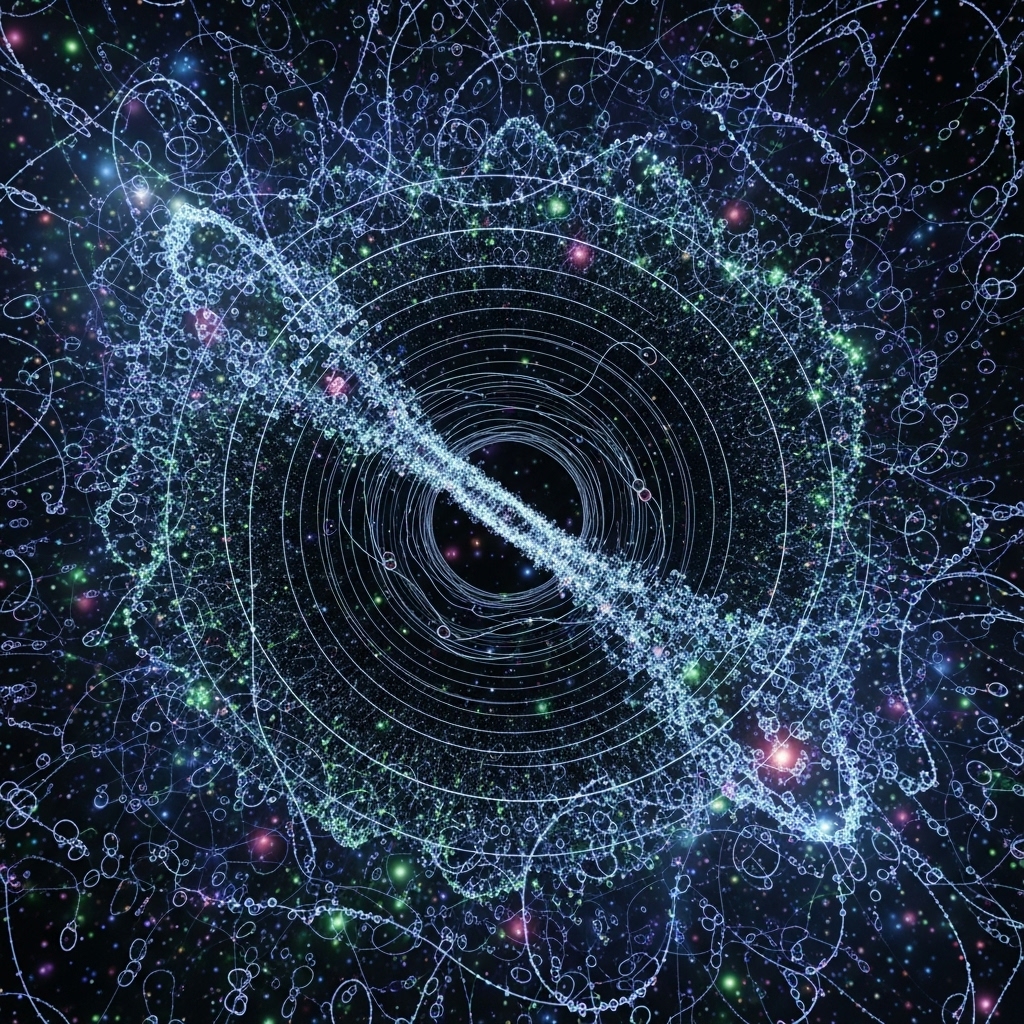
Introduction to Wormhole Formation in Quantum Foam
The concept of wormholes has fascinated scientists and science fiction enthusiasts alike for decades. These hypothetical shortcuts through spacetime could potentially connect two distant points in the universe, allowing for faster-than-light travel and revolutionizing our understanding of space and time. One of the most intriguing areas of research into wormholes is the theoretical possibility of their formation in quantum foam. In this article, we will delve into the concept of quantum foam, the theoretical framework surrounding wormhole formation, and the possibilities and challenges associated with this idea.
Understanding Quantum Foam
Quantum foam refers to the hypothetical "bubbly" structure of spacetime at the quantum level. According to quantum mechanics, spacetime is not smooth and continuous but rather composed of tiny, grainy, fluctuations that occur at very small distances and timescales. These fluctuations give rise to virtual particles and antiparticles that constantly pop in and out of existence, creating a "foamy" texture. The concept of quantum foam was first introduced by physicist John Wheeler in the 1950s as a way to describe the inherent uncertainty and randomness of spacetime at the quantum level.
Theoretical Framework for Wormhole Formation
Theoretical models suggest that wormholes could be formed in quantum foam through the creation of tiny, stable tunnels or tubes that connect two points in spacetime. These wormholes would be incredibly small, possibly on the order of Planck lengths (approximately 1.6 x 10^-35 meters), and would require a enormous amount of energy to stabilize. One of the key challenges in forming wormholes is the need to overcome the natural tendency of spacetime to collapse or expand, rather than maintaining a stable, tunnel-like structure.
Examples of Wormhole Formation Theories
Several theories have been proposed to explain the potential formation of wormholes in quantum foam. One example is the Einstein-Rosen bridge theory, which suggests that wormholes could be created through the collision of two black holes. Another example is the quantum entanglement theory, which proposes that wormholes could be formed through the entanglement of particles across vast distances. These theories are highly speculative and require further research to determine their validity.
Challenges and Limitations of Wormhole Formation
Despite the intriguing possibilities of wormhole formation in quantum foam, there are several challenges and limitations that must be considered. One of the main challenges is the enormous amount of energy required to stabilize a wormhole, which is far beyond our current technological capabilities. Additionally, the gravitational forces and radiation that would be present near a wormhole would make it extremely difficult to navigate or maintain stability. Finally, the theoretical framework for wormhole formation is still highly speculative and requires further research to determine its validity.
Implications of Wormhole Formation
If wormholes were to be formed in quantum foam, the implications would be profound. Faster-than-light travel would become possible, allowing for the exploration of distant reaches of the universe in a relatively short period. Additionally, wormholes could potentially be used for time travel, allowing us to visit different points in the past or future. However, these possibilities are still highly speculative and require further research to determine their feasibility.
Conclusion
In conclusion, the theoretical possibility of wormhole formation in quantum foam is a fascinating and complex area of research. While the challenges and limitations are significant, the potential implications of wormhole formation are profound. Further research is needed to determine the validity of these theories and to explore the possibilities of wormhole formation. As our understanding of quantum mechanics and spacetime continues to evolve, we may uncover new and exciting possibilities for wormhole formation and the exploration of the universe.