
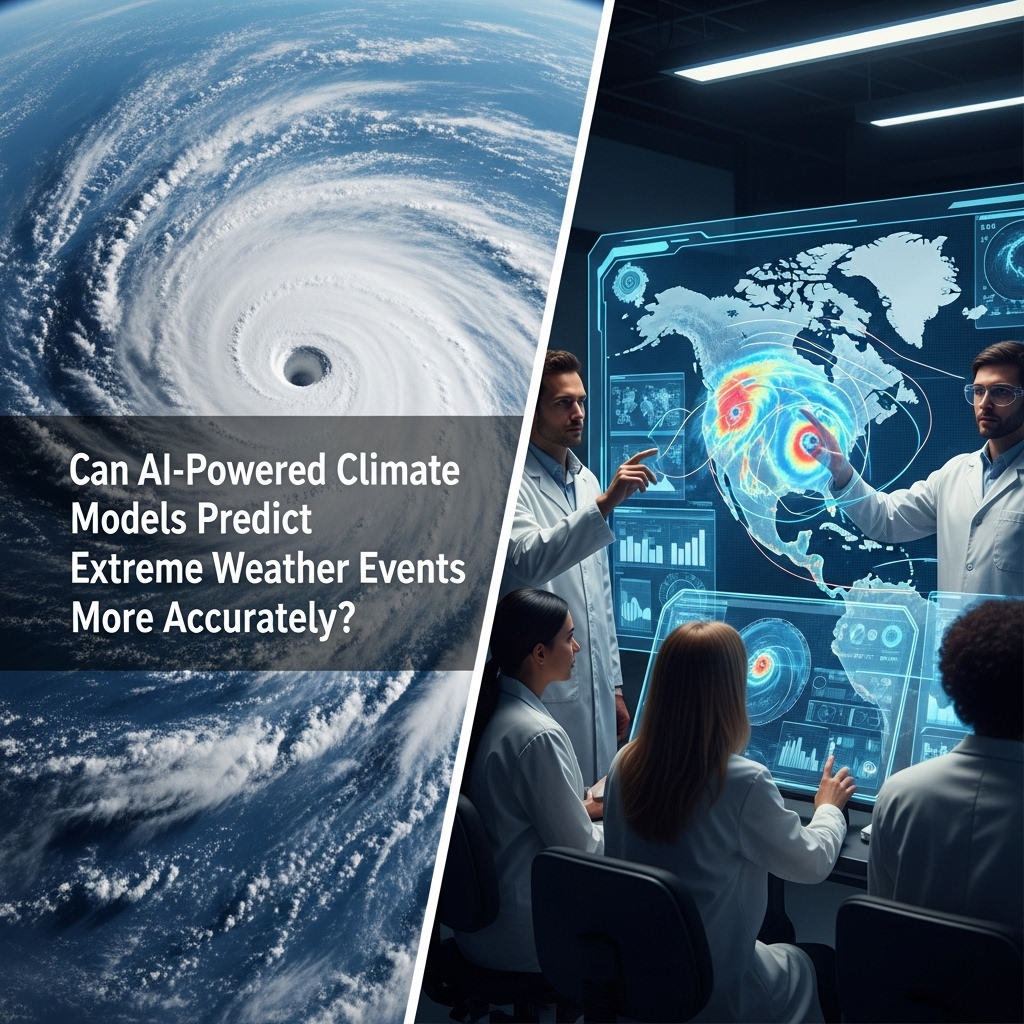
Introduction to AI-Powered Climate Models
The increasing frequency and severity of extreme weather events, such as hurricanes, droughts, and wildfires, have highlighted the need for more accurate climate modeling and prediction. Traditional climate models have been used for decades to forecast weather patterns, but their accuracy has limitations. Recently, the integration of Artificial Intelligence (AI) into climate modeling has shown promising results in predicting extreme weather events more accurately. In this article, we will explore the potential of AI-powered climate models in predicting extreme weather events and their benefits over traditional models.
Understanding Traditional Climate Models
Traditional climate models are based on complex algorithms and physics equations that simulate the behavior of the atmosphere, oceans, and land surfaces. These models use historical climate data, such as temperature, precipitation, and atmospheric conditions, to forecast future climate patterns. However, traditional models have limitations, including simplifications and assumptions that can lead to inaccuracies. For example, traditional models often struggle to capture the complexity of cloud formation and precipitation patterns, which can significantly impact the accuracy of weather forecasts.
How AI-Powered Climate Models Work
AI-powered climate models use machine learning algorithms to analyze large datasets of historical climate information and identify patterns that may not be apparent through traditional modeling techniques. These models can learn from experience and improve their predictions over time, allowing for more accurate forecasts. AI-powered models can also incorporate multiple sources of data, such as satellite imagery, weather stations, and sensor data, to create a more comprehensive picture of the climate system. For instance, AI-powered models can analyze satellite images to detect early signs of hurricane formation, allowing for earlier warnings and more effective evacuations.
Advantages of AI-Powered Climate Models
AI-powered climate models have several advantages over traditional models. Firstly, they can analyze large datasets more efficiently and accurately, allowing for more detailed and nuanced predictions. Secondly, AI-powered models can learn from experience and adapt to new data, enabling them to improve their predictions over time. Finally, AI-powered models can provide more localized and specific forecasts, allowing for more effective decision-making and resource allocation. For example, AI-powered models can predict the likelihood of flash flooding in specific areas, enabling emergency responders to target their efforts more effectively.
Real-World Applications of AI-Powered Climate Models
AI-powered climate models are being used in a variety of real-world applications, including weather forecasting, climate risk assessment, and disaster response. For instance, the National Oceanic and Atmospheric Administration (NOAA) is using AI-powered models to improve its weather forecasting capabilities, including predicting the trajectory and intensity of hurricanes. Additionally, companies such as The Climate Corporation are using AI-powered models to provide farmers with more accurate and localized weather forecasts, enabling them to make more informed decisions about planting, irrigation, and harvesting.
Challenges and Limitations of AI-Powered Climate Models
While AI-powered climate models show promising results, there are still challenges and limitations to their adoption. One of the main challenges is the need for large amounts of high-quality data, which can be difficult to obtain, especially in areas with limited weather monitoring infrastructure. Additionally, AI-powered models require significant computational resources and expertise, which can be a barrier to adoption for smaller organizations or countries with limited resources. Finally, there is a need for more research and validation of AI-powered models to ensure their accuracy and reliability.
Conclusion
In conclusion, AI-powered climate models have the potential to predict extreme weather events more accurately than traditional models. By analyzing large datasets and learning from experience, AI-powered models can provide more detailed and nuanced predictions, enabling more effective decision-making and resource allocation. While there are challenges and limitations to the adoption of AI-powered climate models, the benefits of improved accuracy and reliability make them an exciting and promising area of research and development. As the field continues to evolve, we can expect to see more widespread adoption of AI-powered climate models, leading to better predictions and more effective responses to extreme weather events.